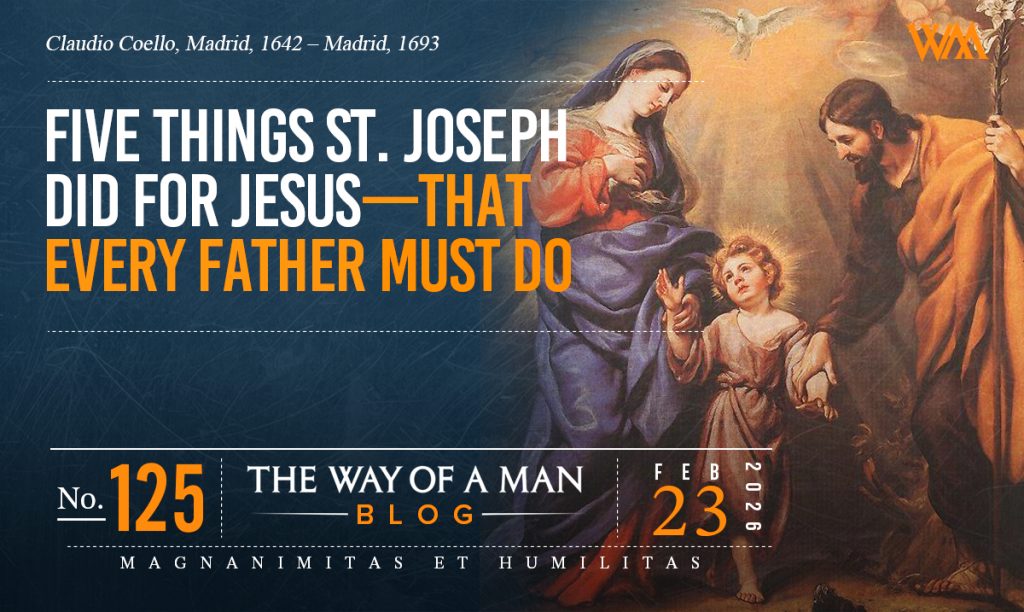



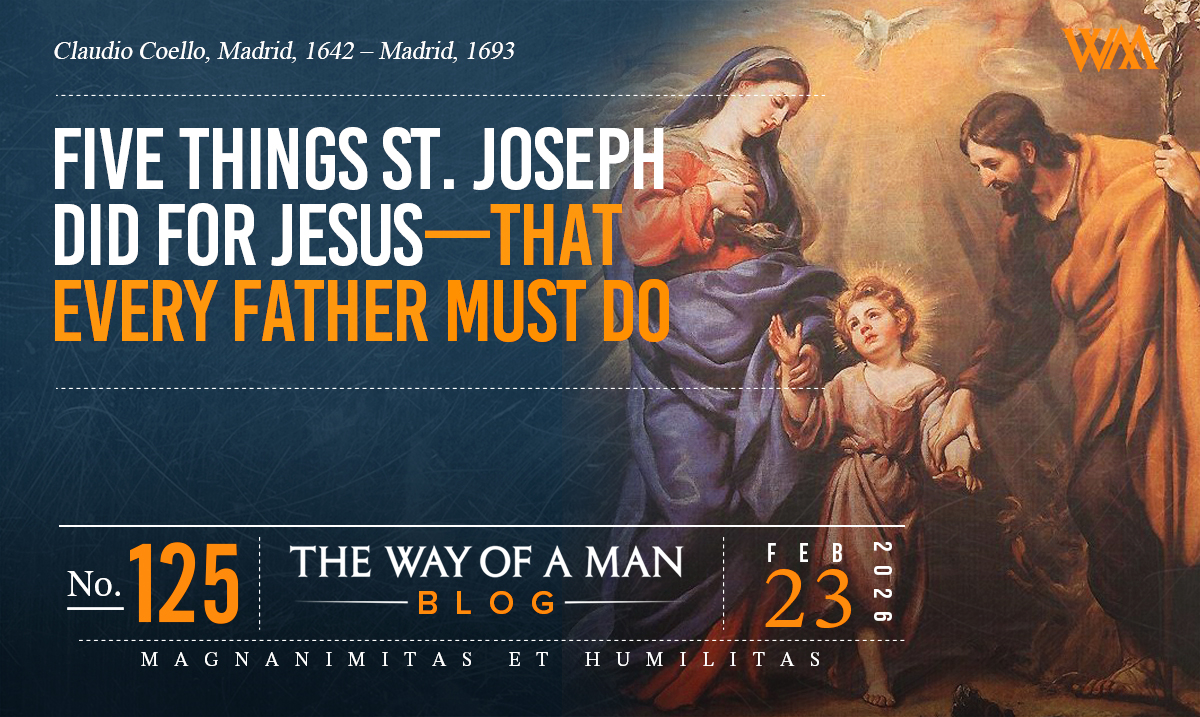
Devin Schadt / February 23rd, 2026
The Way of a Man Series | #125
3417 words
The Catholic Vision of Fatherhood: Learning Fatherhood from St. Joseph
Men’s group study guide available here.
Preface
(To proceed directly to the article, scroll to: The Lost Vision of Fatherhood.)
This article presents a Catholic vision of fatherhood rooted in the silent, sacrificial witness of St. Joseph, showing fathers how to lead their families toward God.
What You Will Find in This Article
• A restoration of the Catholic vision of fatherhood modeled by St. Joseph
• An explanation of why the modern crisis of fatherhood is both spiritual and generational
• A clear description of the mission and responsibility entrusted to fathers by God
• Practical insight into how a father forms, protects, and offers his children to God
• The foundational framework behind the Fathers of St. Joseph apostolate and the Custos vision of fatherhood
The Lost Vision of Fatherhood
We don’t know how to father.
It is not our fault.
We have inherited an absence of the true vision of godly, holy fatherhood.
We need St Joseph’s fatherly example.
My father-in-law, Kenny, was fearful of needles and nurses, doctors and dentists. He avoided them like the plague. Kenny was also an alcoholic—an angry alcoholic. He would often call me after, or while, he had been drinking.
On one occasion, Kenny called. I couldn’t understand a blessed word he was saying and consequently surmised that he was binging on the bottle. I stopped him mid-sentence: “Kenny, you’re mumbling. Have you been drinking?”
To which he responded, “Hold on.” There was a pause, and suddenly his words were clear as a bell.
“Can you hear me now?”
It was like a Verizon ad gone bad.
“My dentures don’t fit right and hurt terribly—I just needed to adjust them.”
Relieved that he wasn’t drunk, I responded, “Kenny, you really need to call your dentist and get those dentures fixed.”
“I hate dentists.”
“Kenny, just do it.”
Well, Kenny called his dentist. The receptionist answered the phone. He explained his situation to her, describing the pain and discomfort caused by his dentures not fitting correctly.
She proceeded to ask him, “Sir, how long have you had your dentures?”
“About 30 years.”
Extended pause…
“Sir, that’s a long time for having a single set of dentures.”
To which Kenny responded, “You think that’s bad? They were my dad’s before he gave them to me.”
Perhaps we have not inherited anything as macabre as a stained set of dentures. But our fathers have passed down to us a void—a lack of vision of fatherhood—and our generation, and the generations that follow, are suffering because of that lack of vision.
Indeed, as the proverb, speaking in the voice of God, laments: “For lack of vision my people perish.” (Prov. 29:18)
Fathered by the Father of Lies
Sociological research, mountains of statistical data, and common human experience attest that fatherhood is the epicenter of everything. As the father goes, so goes the world.[i]
A recent United Kingdom study titled “Lost Boys”[ii] stated that one in every five boys has no father of any kind. In America, it is one out of every four. Over half of children live without their biological father, and I would contend that the majority of those children who live with their biological father lack a true spiritual father.
In fact, it is more likely that our children will have a smartphone than a father.[iii]
Our children are fathered by the phone, which means that they are mentored and coached by influencers and seducers on all social media platforms, which consequently means that they are fathered by the father of lies—the murderer, the liar, the deceiver—Satan himself.
This is the current state of affairs.
Robert Waldinger notes that 80% of Zoomers’ life goals are to be wealthy, and 50% aspire to be famous.[iv] Gen Z has a 42% depression and suicidality rate—twice the American adult average.[v]
The father of lies is coaching our children to seek that which only leads to discouragement, despair, and death.
Kill the Comfort or the Comfort Will Kill You
At the core of the famine of fatherhood is the constant conditioning by comfort.
Comfort, and the desire to comfort the flesh, has spiritually neutered not only the worldly man, but the man of Christ.
There are only two paths regarding comfort:
Kill the comfort, or the comfort will kill you…and your children.
To be uncomfortable is good.
Discomfort from being hungry, over-tired, over-worked, from bodily and emotional pain, is necessary for us to know and understand Christ. When we avoid killing comfort and constantly seek fleshly consolation, we snuff out the voice of Christ.
Sacrifice—especially of comfort—is the mark of a true Christian man, and essential to being a father who is worthy of imitating and following.
Two Types of Men
There are two types of men:
Those who sacrifice themselves to God for their children’s souls, and those who sacrifice their children’s souls to the devil and the world for themselves.
There are two things that separate the man who sacrifices his children to the devil from the man who sacrifices himself to God for his children:
He is determined to be the face of God the Father that his child cannot see; the voice of God the Father that his child cannot hear; and the touch of God the Father that his child cannot feel.
He knows that the human father’s mission is, as St. Pope John Paul II proclaimed, “to reflect and reveal God the Father.” (Familiaris Consortio, 25)
Ask yourself: Do I know who God the Father is? Do I believe that He is absolute good? Do I trust Him with my life? Am I transmitting the goodness, love, and trustworthy character of God the Father to my children?
He chooses his child rather than accepting or tolerating his child. A father in the image of God the Father is akin to the Prodigal Father (Luke 15:11–32), who seeks out his prodigal son day and night, and when he spots a faint glimmer of his emaciated body on the horizon, madly sprints to him and embraces him.
Notice that this father refuses to sit on his gluteus maximus and presumptuously wait for his son to come to him…
No. He runs out to his son; he chooses him.
Ask yourself: When was the last time you invited your son or daughter to go out for coffee with you; to the hardware store with you; to do something they like to do—with you?
When was the last time that you started a conversation with your child for no other purpose than to hear about his or her life, how they are feeling, what they are hoping for, and what they are needing?
Or do you interpret your child’s presence as an interruption or an interference in your plans?
Excuses Don’t Justify Negligence
“But you don’t know my son.”
“But you don’t know my daughter.”
“My kid is a rebel.”
“My son is transitioning.”
“My boy has left the faith.”
“My girl dresses like a slut.”
“My kid doesn’t want to spend time with me.”
“My kid hates me.”
Those may appear to be justifiable excuses as to why you ought to surrender the pursuit to reflect and reveal God’s fatherhood to your children; but as my father-in-law Kenny (the denture guy) would often say, “Excuses are like buttholes; everybody has one.”
Your child may appear to hate you.
It may seem that your child doesn’t want anything to do with you.
It could be that your child, after years of vying for your attention, affirmation, and affection, has surrendered the desire and the effort to obtain your love.
Often our children are distant because they have felt our distance.
Often our children rebel against us because they know that we have rebelled against God.
Often our children stop trying to love us because they feel that we have stopped trying to intentionally love them.
Often our children refuse to choose us because they know we have not chosen them—over ourselves.
After I had given a talk at a men’s retreat, a father in the crowd stood up and retold the story of his teenage son who has stopped talking with him. The silent treatment endured for over a year. He recounted that he took his son out to Subway hoping to have a breakthrough. They ordered their meal, sat down in the booth, and his son looked anywhere but at his dad. Exhausted and exacerbated the father asked his son, “Son, when was the last time it was good between us?”
To which his son responded, “When you wanted to be with me.”
The son proceeded to recount the exact time when his dad asked him to go outside and play catch with the baseball.
Your child may appear to not want to be with you, because your child desperately wants you to be with him.
What You Can Change
You and I cannot change our children.
But we can love them.
And loving them is the greatest power to influence them.
And loving is expressed in sacrificing for them rather than sacrificing them to this fallen world’s maxims and lies.
So where do we begin?
As St. John of the Cross says, “Where there is no love, put love, and there will be love.”[vi]
How can we put love where there is no love?
Remember: “Love covers a multitude of sins.” (1 Peter 4:8)
Love is what converts the heart.
What Your Will Find Here
In this reflection, you will encounter:
- A clear diagnosis of the modern crisis of fatherhood
- Why comfort, not weakness, is the greatest enemy of the Christian father
- How St. Joseph models spiritual authority, sacrifice, and presence
- Five concrete actions St. Joseph took that every father must imitate
- A path forward for fathers who desire to reclaim their role as spiritual leaders
Five Things Joseph Did for Jesus
St. Joseph wasn’t a man of words, but rather a man of solemn, sacrificial action.
His silence speaks profoundly of what it means to be a holy father.
Below are five basic, fundamental things that we dads can learn from St. Joseph in order to be a father like him: a father on earth like the Father in heaven.
1. St. Joseph Spiritually Adopted Jesus
St. Joseph made the decision to sacrifice himself, his ambitions, and his comfort for the sake of protecting, providing for, and being the father-priest of Jesus.
Though Jesus was not Joseph’s biological son, nevertheless, St. Joseph made the intentional decision to be a father to the Son of God.
There is an ancient Roman custom that a child would be laid on the ground after it was born.
Before the Pater Familias, the father of the family, would touch the child, he would inspect the child for any defects or blemishes. For any reason he saw fit—even if he did not like the sex of the child—he could have the child thrown to the wolves or drowned to death.
As morbid as this custom was, there was a pinnacle moment when the Pater Familias would lift the child from the ground and hold the child against his chest.
This embrace, called susceptio (Latin meaning “received”), was an action that legally signified that the father claimed the child as his own.
St. Albert the Great (a teacher of St. Thomas Aquinas) said that though St. Joseph was not the biological father of Jesus, nevertheless, he became the greatest father by claiming Jesus as his own son. [vii]
St. Joseph understood that receiving Jesus as his own son transcended biological fatherhood.
Any man can be a biological father, but it takes a real man to be a spiritual father.
St. Joseph intentionally stepped into his mission to be a spiritual father to the Son of God.
By receiving Jesus as his own son, Joseph was receiving the mission to be a father like God the Father.
What about us? Have we made it our aim and mission to be spiritual fathers to our children—to lead them purposefully to God the Father?
I think we can be easily duped.
I hear men say, “I have done everything to keep my kid Catholic—but now they are falling away.”
Our first goal is not to “keep our kids Catholic.”
Our children can remain Catholic and also remain in hell.
Our primary goal is to show them the Father.
By showing them God the Father, we keep our kids Catholic…and consequently out of hell and in heaven.
St. Joseph teaches us that we are to decide, with intention and determination, to be like God the Father and spiritually adopt our children, as God the Father adopts us in Christ.
Indeed, Christ tells us that whosoever receives one such child in His name, he is greatest in the Kingdom (Matthew 18:5); and the Father and He will come to him and abide in him (Mark 9:37).
Those are incredible rewards.
2. Joseph, with Mary, Consecrated Jesus to God His Father
After the days of Mary’s purification, according to the Torah, had been fulfilled ritually, Joseph and Mary brought Jesus to the temple in Jerusalem to consecrate Him to God (see Luke 2:22–40).
Joseph, in union with Mary, began their parenthood with the pinnacle petition: God, we don’t want our child Jesus for ourselves; we want to raise Him to be an offering to You.
Joseph consecrated Jesus to God so that Jesus may be sacred—hagios—to the Lord. Hagios[viii] means different, other than the world, set apart for a sacred mission.
Let’s ask ourselves: Have we intentionally consecrated our children to God?
I realize that by baptizing our children we could believe that this has sufficiently consecrated them to God.
Yes, sacramental baptism is the absolute necessary first step to consecrating our children to God.
However, it is our duty as fathers, with our wife, to offer our children to God daily.
One way to ensure that your consecration of your child is immovable and permanent is to daily ask Mary and Joseph to do what they did for Jesus: to consecrate you and your children to God.
Mary and Joseph are our parents in the order of grace.[ix]
Jesus is their son, and consequently we are Jesus’ brother; Mary and Joseph are our parents.
Joseph wants you to give your children to him and Mary, and they will in turn offer your children to God.
We can do this by simply praying something like: “Mary, St. Joseph, my parents in the order of grace, I offer my child to you. Please present my child, through Jesus, with Jesus, in Jesus, to God the Father, that he/she may be holy, sacred unto the Lord.”
3. Joseph Took Jesus to the Temple
On multiple occasions, Sacred Scripture attests to Joseph’s fidelity to the religious customs and mandates of his Jewish religion.
Joseph, along with Mary, had Jesus circumcised on the eighth day, according to the prescriptions of the Law (see Luke 2:21).
Joseph, along with Mary, presented their first-born son in the temple to fulfill the “ransoming of the first-born son” (see Luke 2:22–40).
Joseph and Mary, according to tradition, went up to Jerusalem for the Passover each year, and when Jesus was twelve years old, they brought him with them.
In other words, Joseph incorporated Jesus into his own worship (see Luke 2:41–52).
St. Joseph displayed his fidelity to the Law, the Jewish customs, and the fulfillment of holy days. Joseph was a man of worship who showed Jesus how a man worships.
Let us ask ourselves: Do I take my child to the temple? Do I set the pace in this area? Or do I simply fulfill my weekly obligation of “attending” Mass?
Do I demonstrate to my child how important sacramental confession and the Holy Eucharist are to me?
Telling our children how important confession and the Eucharist should be for them is not the answer.
Our children need to know how important and essential Our Lord and His sacraments are to us—and then these things will be important to them.
4. Joseph Sought Jesus Out
Joseph and Mary brought the twelve-year-old Jesus to the temple in Jerusalem for the feast of the Passover (see Luke 2:41–52).
When the days of the feast were completed, Mary and Joseph began their return journey home to Nazareth.
After a day’s journey, they could not find the boy Jesus amidst their kinsfolk or their traveling companions.
Mary believed Jesus to be with the male caravan; Joseph believed Jesus to be with Mary and the female caravan; but Jesus was with His Father in the temple.
Mary reveals her subjective torment, anxiety, and heart-stricken grief in her words to her Son after finding Him: “Son, why have you treated us like this? Your father and I have been anxiously searching for you.” (Luke 2:48)
They lost Jesus.
Joseph took his eyes off of his son.
To see Mary’s torment surely struck at the core of Joseph’s heart, inflicting tremendous grief upon his soul.
Joseph had only one goal: to relieve Mary of her torment—to do whatever it would take to find Jesus and that she be reunited to her Son.
Can you imagine?
Jerusalem was packed with pilgrims.
Josephus, the Jewish historian, contends that approximately two million pilgrims flooded Jerusalem for the annual feast of the Passover.[x]
Joseph scanned the crowds—hundreds of thousands of people—looking for his son’s face.
With tremendous anxiety, worry, and alarm, he called aloud his name.
Three days of fruitless search.
Exhausted, defeated, all hope appeared to be lost…
And then, there in the temple, Joseph and Mary found Jesus listening to the scholars of the Law and asking them questions.
Joseph took his eyes off of Jesus; and yet he was resolutely determined to do whatever it demanded to find him.
What about us?
Have we lost sight of our children?
When was the last time you looked your child in the eyes and expressed your delight in him/her?
When was the last time that you stopped what you were doing, looked into your child’s eyes, and listened to what they were saying—regardless of whether you deemed it worthy of your attention?
Many of us have strained relationships with our children.
It is time for us to be like St. Joseph and bridge the gap, hunt them down, and when finding them, assure them of our love—regardless of their spiritual state.
This may demand that you ask your child for forgiveness for having “taken your eyes” off of him/her.
In other words, we may need to ask our child to forgive us for being addicted to our work, looking at the face of our phone instead of his or her face; for desiring to hang out with our friends more than spending time with them.
Asking your child forgiveness for losing them is the beginning of winning their trust.
Warning: If you plan on asking your child forgiveness for losing sight of him, be certain to change that pattern; otherwise, your child won’t believe in your contrition.
5. St. Joseph Blessed Jesus
According to Jewish custom and tradition, the night preceding the sabbath and great feasts, a Jewish father would bless his child.[xi]
St. Joseph blessed Jesus thousands of times.
If God deemed it necessary that the Son of God be blessed by a human father, how much more should we fathers bless our children.
You and I are priests of our domestic church—our family.
As priests, we are called by God to be “distributors of God’s manifold grace.” (see 1 Peter 4:10)
We have been, by divine right, given the authority to impart God’s blessing, favor, and protection upon our children.
Filling the Void with God’s Presence
The devil relishes a void and desires to fill that emptiness with his demonic presence.
Jesus testifies to this in His parable wherein He describes a man who has been exorcised and the devil, now cast out, roams amidst arid regions in order to find a new home (see Matthew 12:43–45).
Yet, not finding a suitable domain to inhabit, he finds seven more demons, more wicked and powerful than himself, and they return to possess the man.
Why?
It is never enough for evil to be purged from the soul.
After evil is vanquished from the soul, the person must allow that space of the soul to be subdued by the divine presence.
Then, and only then, will the demons be rendered powerless.
You and I, as the priest-father, are to bless our children (and our wives) daily, to fill that void in their soul with the Heavenly Father’s presence, love, and delight.
We are called to impart grace and favor unto them.
Though your children may resist your blessing initially, eventually they will come to you asking for it.
It is in the moment that you bless your child that you become like St. Joseph—a living reflection of God the Father. You become the face of God the Father that your child cannot see; the voice of God the Father that your child cannot hear; and the touch of God the Father that your child cannot feel.
Let us follow St. Joseph’s silent example of sacrifice. By doing so, we impart to our children a vision of fatherhood and strongly connect them to God the Father.
For a deeper explanation of masculine order and leadership, read The Well-Ordered Man.
Related Reflections on Catholic Fatherhood and Masculinity
The following articles expand upon the themes presented here and provide further formation for Catholic men and fathers:
From The Catholic Gentleman
- St. Joseph and the Art of Silent Strength
https://catholicgentleman.com - Why Fatherhood Is a Spiritual Office
https://catholicgentleman.com - The Crisis of Fatherhood Is a Crisis of God
https://catholicgentleman.com
From Sword & Spade
- The Return of Sacrificial Masculinity
https://swordandspade.org - Comfort Is the Enemy of Strong Men
https://swordandspade.org
From Heroic Men
- St. Joseph: Model of Strength, Silence, and Obedience
https://heroicmen.com - Why Fathers Must Lead Spiritually
https://heroicmen.com
Endnotes/Resources:
Men’s group study guide available here.
[i] https://pmc.ncbi.nlm.nih.gov/articles/PMC4235963/
https://www.niussp.org/family-and-households/americas-single-parent-households-and-missing-fathers/
https://nces.ed.gov/pubs98/fathers/
Show Us the Father; Devin Schadt; 2016 Totus Tuus Press;
[ii] https://www.centreforsocialjustice.org.uk/wp-content/uploads/2025/03/CSJ-The_Lost_Boys.pdf
[iii] https://fathersofstjoseph.org/fathered-by-the-phone/
[iv] https://www.mindful.org/what-makes-a-good-life-lessons-from-the-longest-study-on-happiness/
[v] https://en.wikipedia.org/wiki/The_Anxious_Generation
[vi] https://carmeliteinstitute.net/the-power-of-love-in-saint-john-of-the-cross/
[vii] Joseph and Jesus, Francis L. Filas, S.J.; The Bruce Publishing Company, Milwaukee; 1952
[viii] https://biblehub.com/greek/40.htm
[ix] See Custos: Total Consecration Through St. Joseph, Devin Schadt, 2020
[x] https://christianhistoryinstitute.org/magazine/article/on-the-road#:~:text=Pilgrims%20went%20up%20to%20Jerusalem,demanding%2C%20dangerous%20paths%20so%20frequently.
[xi] https://www.learnreligions.com/blessing-the-children-on-shabbat-2076757#:~:text=Traditionally%20Shabbat%20includes%20special%20blessings,and%20reciting%20the%20blessings%20below.

Devin Schadt
Executive Director | The Fathers of St. Joseph
Related Resources
Related Articles