

Devin Schadt / April 13th, 2026
The Way of a Man Series | #133
3554 words
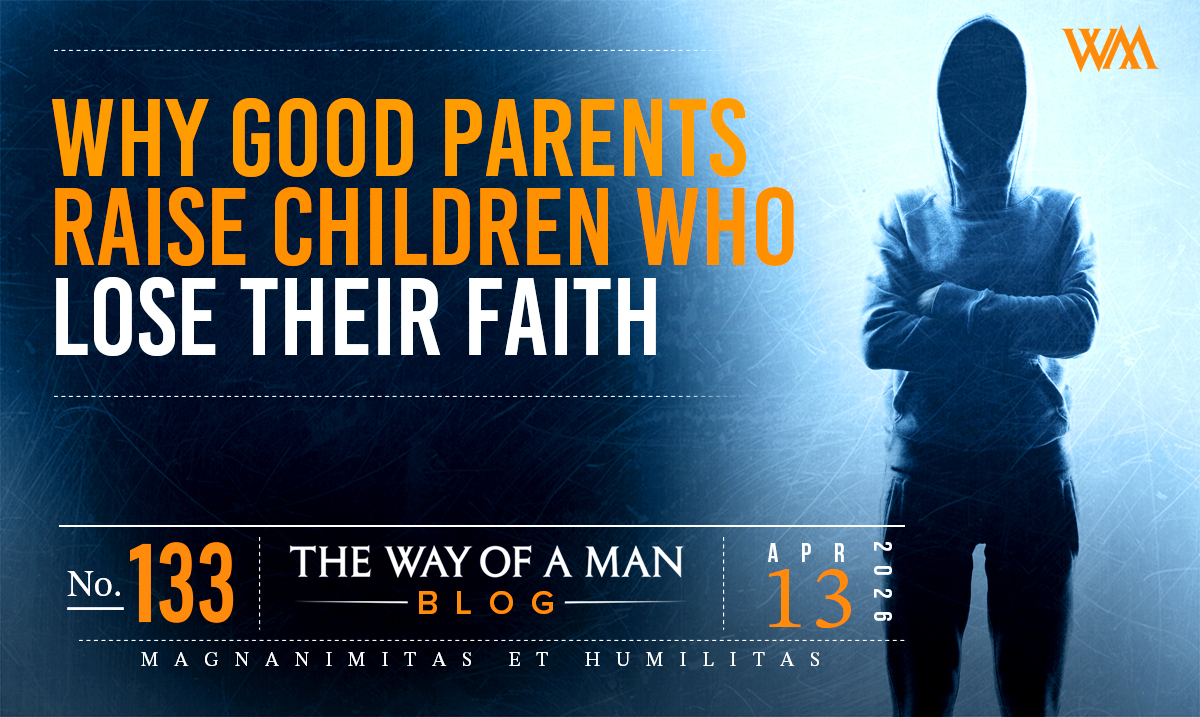
Why Good Parents Raise Children Who Lose Their Faith
What this article is about:
Why even good and faithful parents can lose their children to the world—and the critical mistake that determines whether a child grows toward God or away from Him.
What you will find in this article:
- Why blaming yourself—or your child—is a dangerous spiritual error
- How modern parenting subtly forms children to conform to the world
- The hidden danger of fearing the loss of your child’s approval
- The biblical example of Eli and what it reveals about failed fatherhood
- Practical steps to build trust, enforce consequences, and form virtue
- The true measure of a father’s success in the eyes of God
Why Good Parents Raise Children Who Lose Their Faith:
Is There a Hidden Parenting Mistake That Drives Children Away From God?
Why Do ‘Good’ Parents Have ‘Bad’ Children?
It’s becoming an epidemic.
Holy parents raising apostate children.
For example, we all know parents who are pursuing holiness whose children have left the Church.
Moreover, faith-filled fathers are heartbroken that their children identify as gay, binary, trans—or as any of the supposedly 600 varying ways to identify.
Recently, a young father asked the difficult question, “Why are children of good fathers, from good families, leaving their faith behind?” …
“What is the x-factor for parenting? How do I avoid losing my children to the devil?”
Indeed, this is the 64-million-dollar question.
Who Is To Blame For A Rebellious Child?
Frequently, parents blame themselves for their child’s rebellion.
On the other hand, some parents self-justify and defer the blame entirely to their children.
Consequently, both types of parents fall into a satanic self-deception.
Thus, the parent who blames themselves for their child’s rebellion inadvertently and subconsciously believes the lie that they are God.
In essence, they believe they have the power to control their child’s spiritual outcome.
However, God Himself does not exercise that type of autocratic, domineering, micro-managing control.
Indeed, He affords every human being free will and the capacity to choose their own destiny.
On the contrary, the parent who defers all blame, refusing to acknowledge any personal influence or deficiency, like Pilate, washes their hands clean of their responsibility for their children.
This parent blames the devil, the world, the flesh for their child’s apostasy.
“Teens will be teens.”
Consequently, these types of parents assume little to no responsibility.
In the final assessment, both types of parents render themselves incapable of doing anything positive that could attract their child to God.
Indeed, the former will continue to attempt to control the child, while the latter will exercise minimal effort in guiding their child.
In effect, one child refuses to draw near to his or her parents, or God, for fear of being controlled.
Conversely, the other child believes that God is like his parents: He simply doesn’t care about what decisions he makes.
Children Raising Children
However, it is essential that we realize that we are imperfect parents attempting to raise perfect children.
Indeed, the philosophical principle commonly known as the Law of Causality roughly states that nothing can produce something greater than itself.
Or, as the Latin saying goes, “nemo dat quod non habet”; one cannot give that which one does not possess.
Accordingly, we put too much emphasis on nature and the natural law while diminishing the factor of supernatural grace.
In other words, we put too much emphasis on our own power and not enough on God’s power and mercy.
Nevertheless, we are not to let ourselves off the hook.
We will answer to God for our parenting.
God will judge our fatherhood and the pattern by which we have fathered our children.
In fact, this is the point of Christ’s parable of the talents.
You and I are responsible for the manner by which we invest in our children.
Assessing the Root of Parental Weakness
There exists a massive danger, a precarious parental “method,” that does not raise children to love God but rather conditions them to conform to the world and to be worldly.
In fact, just in case we don’t think that being of the world is a “bad” thing, I will reference a small selection of divinely inspired scripture passages that reaffirm the perennial teaching that the world is evil.
Jesus condemns the Jews, “You are from below; I am from above. You are of this world; I am not of this world.” (John 8:23)
Jesus before Pilate, “My kingdom is not of this world.” (John 18:36)
St. James cautions us, “If you are a friend of the world, you are an enemy of God.” (James 4:4)
John the evangelist warns us, “If you love the world, the charity of the Father is not in you.” (1 John 2:15)
Whereas St. Paul counsels us, “This is God’s will for you, your sanctification.” (1 Thes 4:3)
Specifically, the Greek root word for sanctification is hagios, which literally means different or other.
God calls us to be hagios, different than, set apart from the world.
Indeed, Christ says, “But I chose you out of the world.” (John 15:19)
Our goal as parents is to be hagios and to raise our children to be set apart from the world.
However, this is the modern parent’s Achilles’ heel:
We parents of the post-modern, digital industrial era are not demonstrating to our children how not to be worldly.Why?
Because, in fact, we have succumbed to it.
The Idolization of the Child
The crux of the parental dilemma is that we are fearful of losing our children.
Specifically, we fear losing our children’s love, respect and approval.
This fear conditions us to either overstep or understep.
Precisely, parents are afraid of having a child who dislikes them.
Equally important is that a man’s core need is respect.
Consequently, when a father is disliked or even rejected by his child, he interprets that rejection as being disrespected.
Therefore, a weak father will forego disciplining his children, or “forcing” the faith upon his children, for the purpose of gaining his child’s respect.
His primary focus is to make his children comfortable.
Hence, he rarely does anything that will cause his child discomfort.
Indeed, he is more about making life fun than influencing his child to be great.
Conversely, there are fathers who—out of fear—lack a certain sensitivity and tenderness incumbent upon those who raise children.
Specifically, they discipline with physical, emotional, and psychological harshness.
Furthermore, over-controlling fathers will use abusive tactics aimed at manipulating, coercing, and controlling their children.
This type of father systematically undermines his mission to be an image of God the Father.
Indeed, he eclipses and distorts the image of a tender, merciful, patient God who does discipline—yet, with love.
He is more concerned about his name and reputation.
Thus, he reprimands, rebukes and chastises his child for the purpose of upholding his good image.
For the sake of this post, I will not discuss the domineering father figure who maligns the image of God the Father.
Rather, my focus is on the phenomenon of being afraid of losing our children.
Eli’s Idolization of His Sons
Around the 11th century BC, prior to the era of the Israelite monarchy and the institution of the Jewish kings, Eli was priest and judge of Israel.
Specifically, Eli was appointed by God as high priest in Shiloh, where he ministered before God, who filled the Ark of the Lord with His holy presence.
Despite Eli’s duty to God and his holy office, the first book of Kings notes that he was a wicked father.
“Now, the sons of Heli were children of Belial, not knowing the Lord, nor the office of priests to the people; but whosoever had offered a sacrifice, the servant of the priest came, while the flesh was boiling, with a fleshhook of three teeth in his hand, and thrust it into the kettle or into the pan; and all that the fleshhook brought up, the priest took to himself. Thus, did they do to all that came to Shilo.” (1 Samuel 2:12-14)
To clarify, the word Belial means worthlessness, wickedness, or lawlessness.
In other words, Eli’s sons—Hophni and Phineas—literally worshiped rebellion.
Additionally, “Before they burnt the fat, the servant of the priest came and said to the man that sacrifices: Give me flesh to boil for the priest; for I will not take of thee sodden flesh, but raw.” (1 Samuel 2:15-16)
“Wherefore the sin of the young men was exceedingly great before the Lord, because they withdrew men from the sacrifice of the Lord.” (1 Samuel 2:17)
Furthermore, “Eli was very old, and he heard all that his sons did to all Israel, and how they lay with the women that waited at the door of the tabernacle.” (1 Samuel 2:22)
“And [Eli] said to them: Why do ye these kinds of things, which I hear—very wicked things—from all the people?” (1 Samuel 2:23)
“And [Eli’s sons] hearkened not to the voice of their father…” (1 Samuel 2:25)
The Sin of Eli’s Sons
To summarize, the sins of Heli’s sons were:
First, Eli’s sons “commit the liturgical abuse of stealing meat from the sacrifices dedicated to the Lord” (see A Catholic Introduction to the Bible; The Old Testament, Bergsma and Pitre; p. 357).
Second, they commit the liturgical abuse of “sexual transgressions, by having relations with the women who served at the entrance of the tent of meeting.” (Ibid.)
“Although, at first glance, the two sins might seem unrelated, in an ancient Israelite context, it is important to recall that the relationship between God and his people was viewed as a nuptial covenant and that acts of cultic infidelity were considered ‘spiritual adultery.’” (ibid.)
Third, the sons of Eli, because of their wicked deeds, caused people to withdraw from bringing their sacrifices to Shiloh.
Consequently, the Jews who refrained from bringing their sacrifices to Shiloh transgressed the Law.
Therefore, Hophni and Phineas not only sinned against the Lord but caused others to transgress God’s commands.
Eli’s Transgression: Love of the Creature Over the Creator
Though Eli verbally rebuked and warned his sons regarding their wicked deeds, he took no disciplinary action against them.
Indeed, Eli’s duty was to remove his sons from their position of authority and publicly denounce them.
But he didn’t.
Eventually, a “man of God” (see 1 Kings 2:27), speaking in the name of God, prophesied Eli’s demise.
“Why have you kicked away my victims and my gifts which I commanded to be offered in the temple? And thou have rather honored thy sons than Me, to eat the first fruits of every sacrifice of my people Israel?” (1 Kings 2:29).
Additionally, the man of God prophetically foretold that Eli’s sons would both perish on the same day and that Eli’s priesthood would be removed and his legacy would be no more.
Eventually, the Philistines waged war upon the Israelites.
During the initial battle, the Israelites suffered a significant defeat.
Consequently, Hophni and Phineas had the ‘brilliant’ idea to bring the Ark of the Covenant into the next battle, believing that God’s presence would afford them victory.
However, during that battle, both Hophni and Phineas perished.
Additionally, the Ark was captured by the Philistines.
Furthermore, a man who had escaped the battle returned to Shiloh, proclaiming the alarming news.
Hence, Eli, upon hearing it, fell backwards from his stool, breaking his 98-year-old neck and died.
The consequences of Eli’s pitiful use of his fatherly authority
First, his sons perish.
Second, their souls are damned, for they died in the state of unrepentance.
Third, the men of God were slaughtered, leaving their wives and children to fend for themselves.
Fourth, the Ark of the Lord was captured by pagan enemies.
Fifth, the central place of worship in Shiloh was now deprived of God’s holy presence.
Why?
Specifically, God proclaims the just verdict, “Because you have honored your sons more than Me.”
Because Eli loved the creature above the Creator.
Eli is the archetype of the modern-day father who, though knowing right from wrong and even professing this knowledge to his rebellious sons, does absolutely nothing to correct them.
Similar to many fathers, Eli avoids straining his relationship with his children.
Hence, he chooses the creature over the Creator.
In fact, this is the perennial sin that has persisted from the very beginning.
Adam, the original man, refused to tell Eve that she should not partake in the forbidden fruit.
Why?
Because he could not bring himself to cause strain or division between him and the lovely wife God had given unto him.
Instead, Adam chose the creature Eve over the Creator God.
Indeed, he chose to strain his relationship with God rather than to strain his relationship with Eve.
Nevertheless, Adam damaged both his relationship with God and with Eve.
From that point on, Adam, and the sons of Adam, lust after Eve and the daughters of Eve.
Additionally, Eve and the daughters of Eve cling to man, manipulating and seducing him to gain a form of invalid validation.
Similarly, when we choose to avoid training our children in the Lord’s ways in order to avoid straining our relationship with them, we inevitably lose both God and our children’s souls.
Lip Service Versus Consequences
When I was much younger, I spent Easter at a friend’s house.
It was on Easter morning that this friend of mine decided to throw a major tantrum about the shirt his mother wanted him to wear to Mass.
Even though he was a teenager, he threw himself down on the ground.
He rolled around on the carpet like he was having a seizure—crying and screaming that he did not want to wear the darn shirt.
I couldn’t believe what I was seeing.
Furthermore, his mother continued to repeatedly chide him.
I don’t know what was worse: watching him kick and scream or his mother’s empty threats.
Additionally, the son knew that there would be no consequence for his abhorrent behavior.
Consequently, he carried on with his tantrum for nearly forty-five minutes, causing the family to be late for Easter Mass.
Although this may sound far-fetched, it was very real.
Even so, when parents enable “victimhood” without enforcing consequences upon their children, the outcome can be downright devastating.
For example, I knew a young man who began using drugs in high school.
Ultimately, he became addicted.
Consequently, to afford his lifestyle, he began to steal from his parents.
Eventually, his parents would catch him and rebuke him.
However, they refused to enforce any real consequences.
In fact, they enabled him.
He refused to get a job.
They complied.
He totaled his car.
They allowed him to use their family cars and total them.
Did the stealing and the addiction stop?
No.
It only worsened—
to the point that this young man ended up in a state penitentiary for committing far more heinous crimes.
Focusing on Keeping Our Kids Often Is the Cause for Losing Them
Often, when our singular focus is “how to keep our kids,” we inevitably lose them.
Additionally, we not only lose them, but they lose their souls.
Like Eli and Adam, we fear losing “connection” and “friendship” with our children.
Hence, we forsake disciplining our children.
However, love without discipline is neglect.
And discipline without love is abuse.
Rather than losing God for the purpose of keeping our kids, we are to keep God even if we lose our kids.
The Results of Choosing Your Kid Over God
If our parenting style consists of chiding while neglecting to enforce real consequences, we can expect the following tragic results:
- By attempting to win your child, like Eli, you will lose their respect
- By losing your child’s respect, your child (like Hophni and Phineas) will neglect your counsel and eventually choose the world and worldliness
- By choosing worldliness, they risk losing their souls
- Like Hophni and Phineas, your child will infect other human beings with their self-centered worldliness. Consequently, more souls will be damned
- Like Eli, your legacy is demolished
- As with Eli, you will be judged by God
Now, you might be thinking that this is harsh.
It is.
Life is harsh.
Whether we like it or not, there are consequences to our action or inaction.
In effect, if you fail to discipline your child, the world will.
In fact, by removing consequences from your discipline arsenal, you do not remove your child from consequences.
Rather, you invite them to become enmeshed in the most tragic kind of consequences.
Chiding, Warning, and Consequences
Often, we want to avoid the tears, the fits, the tantrums.
However, as one man said, “Avoid the tears now and you will reap them later.”
Specifically, how do we discipline our children in a way that they can understand that their actions have consequences?
Several things that are essential to helping your child love God and respect you:
1. Win Their Trust.
Specifically, spend time with them.
Choose them.
Don’t wait for them to ask you to do something.
Rather, you ask them.
Hence, when you make a promise to your child—keep it—no matter what.
Refrain from abusive, demeaning, critical language directed toward your wife or your child.
Additionally, remain master of your emotions.
No physical abuse—whatsoever.
Rather, encourage your child with words of affection and affirmation.
Additionally, listen to your child when they are talking.
Do whatever it takes to pay attention.
Moreover, enter the conversation like it is the most important thing going on in your life (because it is).
And don’t manipulate them.
Why?
Because eventually they will discover that you are manipulating rather than loving and become distrustful of you.
2. One Warning—No More
When your child is doing something that is an infraction against your morals and God’s law, warn them once.
Moreover, do not continue to chide them and correct them verbally.
The child will only tune you out.
Hence, a child thinks, “Dad has told me twenty times that I am going to be in trouble… I don’t believe him.”
One warning.
That’s it.
3. Surprise Consequences
Furthermore, whatever you do, do not tell them what the consequence is.
Simply say something like, “Stop doing that.” Or, “I’m warning you—don’t do that again.”
Accordingly, when the child commits the infraction a second time, you provide the child with a well-thought-out consequence.
For example, your son is hitting his sister.
Consequently, you tell him to stop once, while warning him that there will be a consequence if he does it again.
Nevertheless, he hits her again.
Meanwhile, you have been considering an appropriate consequence.
Later that evening, you take the family out for ice cream.
Subsequently, everyone gets ice cream except for your son, the bully.
The bully is surprised.
Eventually, over time, he will begin to understand that dad says what he means and means what he says.
Additionally, he begins forgoing the risk of weighing his options.
Meaning, “Should I do this, or is dad’s ‘consequence’ going to be worse?”
Eventually, he will assume that dad will follow through and that the consequence will be disadvantageous.
4. Trust is Earned.
By applying this method, even if your child does not “like” you, he or she cannot help but respect your authority.
Moreover, and more importantly, your child learns to fear God.
Often the reason our children don’t fear God, judgement, or the possibility of hell is because they don’t fear and respect our authority.
Remember, you must win your child’s trust.
Consequently, when you discipline your child, your child trusts that you love him.
What Determines a Father’s Success?
To clarify, we do not exercise autocratic control of our children.
They have a will of their own, and they are responsible for their own souls.
However, this does not negate the fact that God requires us to guide, counsel, and influence our children in order that they know, love, and serve Him.
In fact, we are to be a metaphorical magnet that attracts our children to God.
For our part, we are to do whatever we can to win their trust.
Furthermore, we are to do what we can to discipline them properly.
Yet, in the final analysis, we must remain detached from the creature.
To have God the Father’s heart is to love the Creator above the creature.
Remember, a father’s success is not based on his child’s faithfulness.
Rather, a father’s success is based upon his faithfulness to God and to his children.
Consider that God the Father has over 8 billion children on this earth—most of whom are rebels.
moreover, God is not a father-failure.
Why?
Because He patiently waits for His children to come home, winning their trust with His mercy.
Related Articles
- The Catholic Vision of Fatherhood
- Show Us the Father: Your Noble Duty
- Why Children Don’t Need Perfect Fathers- But Present Ones
- Becoming the Well-Ordered Man
- Small Man Syndrome

Devin Schadt
Executive Director | The Fathers of St. Joseph
Related Resources
Related Articles