


Devin Schadt / March 9th, 2026
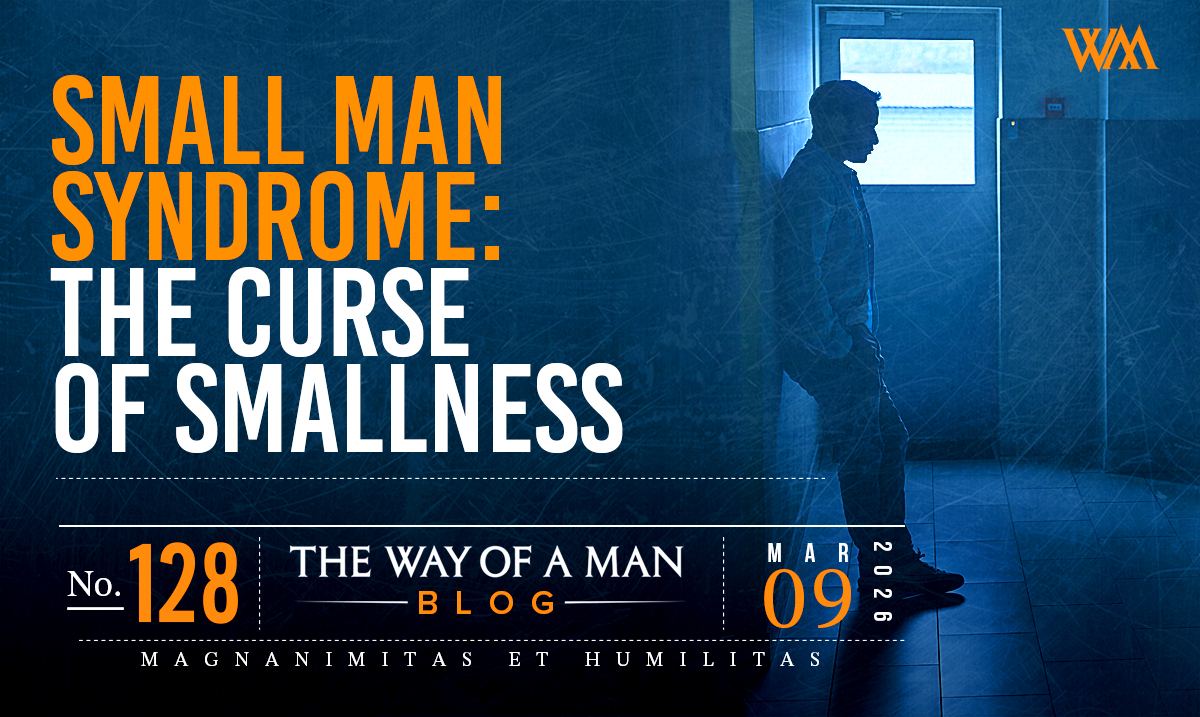
The Way of a Man Series | #128
2189 words
Small Man Syndrome
What this article is about:
Why secret and hidden “smallness,” known as Small Man Syndrome, haunts men and how it leads them away from God and toward spiritual ruin.
What You Will Find in This Article
- Why many men secretly struggle with small man syndrome
- The biblical example of King Saul, and his smallness
- What erodes a man’s self-worth
- The spiritual consequences of low self-value
- The difference between being small in the eyes of men and becoming little before God
Small Man Syndrome: The Curse of Smallness
No one likes to be small.
“Small” has the connotation of weakness, inability, and lack of strength.
Indeed, men subconsciously and consciously interpret “smallness” as a curse.
A man cannot hide being physically small.
Associated with the all-too-conspicuous character of a man’s lack of stature and size is the burden of feeling less than and being perceived as less than.
Yet it is not only those who are lacking in physical stature who are plagued by the stigma of smallness.
Hosts of men—especially those who appear to have external gravitas—are hunted and haunted by the unshakeable feeling that they are indeed small.
Allow me to explain.
It was the halfway point in the men’s conference. Nearly five hundred men migrated to the gym to grab some high-end grub that the ladies of the parish had prepared.
Though I give talks to crowds of men and by all appearances can be perceived as an extrovert, I define myself as an introvert.
My instinct is to avoid the crowd and hide in a dark corner.
As I made my way through the crowd, in hopes of finding that dark hidden corner, an old Irish priest—with lightning in his eyes and a grin on his face—grabbed my arm.
“You’re coming with me—you need to put some meat on those bones.”
“Schadt?” he inquired. “That’s German.”
He proceeded to speak in German—which I could not interpret.
Evidently, he was making a joke about my height (both he and I saw eye to eye).
He was ornery, fun-loving, a real jokester.
“So, you speak German?”
“I used to.”
He stammered, “Prior to my stroke I spoke five languages fluently.”
Then, with a sparkle in his eye and a curl in his lip, he stuttered,
“And now I can barely speak a lick of English.”
The witty priest suffered a terrible stroke which hospitalized him for a lengthy period of time, compromising his cognitive and physical function. The fact that he could talk and walk was nothing short of miraculous.
After we passed through the buffet line we both stood still, looking upon the sea of men. Every seat appeared to be taken.
I looked at him with that expression: “Okay, now what?”
“Come with me.”
Without hesitation the Irish priest approached the young men at one of the tables, commanding a couple of them to grab two chairs.
Within seconds the matter was handled.
He and I were sitting among roughly a dozen men in their twenties and thirties.
The conversation was inspiring.
One man recounted how he had recently converted to Catholicism; another that he was soon to be a priest.
Haunted and Hunted by Smallness
I thanked the men for sharing their stories and signaled with my body that I was about to leave (and again find that lonely corner), when one of the men—who appeared by all means to be a “man’s man”—asked if he could have a word with me.
We separated from the group.
He disclosed to me that even though he was successful in business, somewhat wealthy, aware of his physical strength, and above-average looks, he still felt like a boy—small, weak.
This is common.
All too common.
In fact, the plague of “smallness” haunts many men.
Nearly every conference, every men’s retreat that I attend, there are men who are bold and honest enough to bear this fundamental disquiet that secretly haunts and hunts them.
Why do they disclose it?
Because the pain of feeling small is nearly unbearable.
And that pain, if not addressed, induces and compels a man to find his strength, stature, and respect in ways that will only compound and exacerbate his sense of smallness.
The pain of smallness is connected with—if not born from—the desire to be respected.
Universally, a man’s fundamental, primary, core need is to be respected.
A survey revealed that when men were asked which they would rather have from a woman—respect or love—the vast majority of men responded, “What is the difference?”
Men equate being respected with being loved.
Seeking the Respect of Men
Which brings us to the heart of the challenge: men will often act in ways and do things that run against their beliefs and their conscience in order to sedate and snuff the haunting whisper of smallness.
Take for example Saul, the first anointed king of Israel.
Saul worked as a donkey shepherd who belonged to the smallest of the tribes of Israel, Benjamin.
The Israelites implored Samuel that they might be like the other nations and have a king who would rule over them and lead them in and out of battle.
Disheartened and grieved by the request, Samuel the prophet presented their petition to God, who complied by having Samuel anoint Saul as the first king of Israel.
God chose a lowly man from the smallest tribe of Israel to rule the people.
Armed by God with power, Saul became victorious in battle, conquering the Philistines, which secured his kingship in the people’s minds.
Yet on one occasion God, through the prophet Samuel, commanded Saul to utterly destroy the Amalekites: man, woman, child, and livestock—and that nothing should be retained save that which could pass through fire.
Saul’s Fear of Men
Empowered and anointed by God, Saul and his armies utterly destroyed the Amalekites, holding captive Agag their king.
Post battle, Saul allowed the men to divide the spoils of the livestock and other material goods among themselves.
After the battle, Samuel came to Saul.
Saul perceived Samuel’s presence as God’s approval of his victory.
However, Samuel reprimanded Saul:
“What meaneth then this bleating of the flocks which soundeth in my ears, and the lowing of the herds which I hear?” (1 Samuel 15:14)
Saul proceeded to defend his disobedience by attempting to flatter Samuel:
“They spared the best of the sheep and the herds that they might be sacrificed to the Lord thy God…” (1 Sam 15:15)
The Characteristics of Smallness
Notice that Saul is small-minded.
Saul refuses to own up to his true motive.
He blames his greed upon Samuel and Samuel’s God:
“We held the livestock back to offer to your God.”
Notice that Saul has distanced himself from God.
Samuel rebukes Saul:
“Though little in your own eyes are you not chief of the tribes of Israel? And the Lord anointed you as king over Israel.” (1 Sam 15:17)
Notice what the prophet says.
Samuel reveals to the king that he is “small in his own eyes.”
Because of Saul’s lack of confidence in who he was—who God had made him to be—in his insecurity and lack of true confidence, he turns to men seeking and relying upon their respect.
Indeed, Saul says as much.
“I was afraid of the men and I obeyed their voice.” (1 Sam 15:24)
Saul chose to please men and to maintain their so-called respect. He disobeyed God.
Saul is small because he determines his value and identity by what others think of him.
But human opinion is shifting, elusive, and betrays.
Saul’s Jealousy
Saul’s smallness is further revealed in an incident that would later occur.
David slays Goliath and proceeds to lead the Israelite men into battle, conquering the Philistines.
Upon David’s return from one such victory, the women of Jerusalem ran out to greet the victorious army singing:
“Saul slew his thousands, and David his ten thousands.” (1 Sam 18:7)
“And Saul became exceedingly angry, and this word was displeasing in his eyes. And he said: ‘They have given David ten thousand, and to me they gave only one thousand. What is left for him except the kingdom itself?’” (1 Sam 18:8)
Saul fed on the respect of men.
He derived his identity from human affirmation and opinion.
And when that opinion shifted, Saul’s self-worth diminished.
Self-pity, jealousy, anger, and hatred for one’s fellow man are the grave consequences of being small.
Test yourself.
Do these vicious sentiments assail you?
If so, it is time to address your smallness.
The Consequences of Being Small
The small man is the one whose identity, self-respect, and value are founded upon what men think of him.
His actions, his beliefs, and the way he responds—or does not respond—are conditioned by the question:“What will people think of me?”
Human respect is shifting sand upon which no man should build his house.
Why?
Because people’s adoration is fleeting.
At its root, small man syndrome is driven by the fear of men’s opinion.
Your identity leads to your destiny.
God is your destiny.
Therefore, it is God whom you are to please.
You please God by becoming yourself—the true self—the man whom He created you to be.
But when you live for human respect, you are choosing to be noticed by men rather than to be known by God.
Devastating Consequences of Small Man Syndrome
We must be aware of the consequences of being small-minded.
“Do you not know that to be a friend of the world is to be an enemy of God?” (James 4:4)
“If I am pleasing men, I am not a servant of Christ.” (See Gal 1:10)
Our Lord, who is the most confident of all men, proclaimed, “I do not receive the glory of men.” (John 5:41)
To be worldly is to seek human favor and build your identity on human opinion, which Christ utterly rejects.
And this is the consequence:
“If a man loves the world, the love of the Father does not dwell in him.” (1 John 2:15)
Small-minded Saul sought and lived for human respect, and therefore he lost the respect of God.
The Father and His love departed from Saul because Saul’s love had departed from God the Father.
Saul chose to be respected by the creature rather than to respect and revere the Creator.
His compass was directed by human opinion, and that led him to a deep south destiny.
Samuel’s Confirmation of Saul’s Smallness
Samuel confirms this:
“Why did you not hearken (obey) to the voice of the Lord, but have turned to the prey and done evil in the eyes of the Lord?” (1 Sam 15:19)
Then comes the solemn condemnation:
“Because it is like the sin of witchcraft to rebel, and like the crime of idolatry to refuse to obey. For as much therefore as thou hast rejected the word of the Lord, the Lord hath also rejected thee from being king.” (1 Sam 15:23)
Notice what is at stake.
When you and I live for human honors and the respect of men, we will inevitably disobey God and His commands in hopes of pleasing those men.
The Word of the Lord is clear: disobedience to God is devil worship.
Fathered by the Father of Lies
Saul was small.
He feared men rather than fearing God.
In his desire not to strain his relationship with his admirers, he severed his relationship with the One whom he ought to be admiring.
When we fear the opinion of men more than God and no longer fear damaging our relationship with Him, we become small like Saul.
Small souls sell their souls to be liked by men.
And in doing so they dismiss the very presence of the Father’s love from their being.
They become orphaned.
They are fatherless.
Rather, they are fathered…
By the father of lies, who deceives them into believing that they must bow down to the world if they are to have peace within themselves.
And yet the more they bow down to Satan and his promises, the smaller they feel.
Casting Off the Stigma of Smallness
So often, men live in quiet insecurity, haunted by the fear of men’s opinion and their need for human respect.
However, a man cannot be free until he is no longer governed by the fear of men’s opinion.
Only by casting off the diabolical deception that man’s opinion regarding our person matters can we be free to find our true identity in God the Father—as His chosen son who lives in the Only Begotten Son, Jesus Christ.
This is the true identity of a man: his identity is found in God the Father, not in the shifting opinions of men.
A man’s identity cannot be built on human respect but only on God.
Then and only then will he become great.
Small versus Little
Why?
Because such a man has chosen to be little—dependent on God his Father.
God the Father honors the humble little one with His glory.
For He says as much:
“But to whom shall I have respect, but to him that is poor and little, and of a contrite spirit, and that trembleth at my words?” (Isa 66:2)
He exalts the humble. (Matt 23:12; Luke 14:11; Psalm 147:6; Psalm 113:7; Job 22:29; Luke 1:46–55)
Indeed, there is a vast difference between being small and being little.
The life of the small is riddled by jealousy, envy, and performing.
Much of their actions are for human applause and accolades.
Amen. They have received their reward.
But the little man—yes—“he is greatest in the Kingdom of Heaven.” (Matt 18:4)
Because he knows that only God determines his value, and by becoming little before God—that is, obedient to Him in all matters—God in the end, on the Day of Judgment, elevates him and honors him before all mankind.

Devin Schadt
Executive Director | The Fathers of St. Joseph
Related Resources
Related Articles