



Devin Schadt / March 25th, 2025
The Way of a Man Series | #55
1124 words / Read Time: 9 minutes
The Bully’s 4 Tactics
Am I really responsible for other people’s salvation?
Everyone has free will.
Therefore, it is up to each person to decide his own fate. Right?
It is enough to be concerned with getting myself to heaven.
But doesn’t that seem a bit selfish?
For example, my house is burning down.
My children and wife are fast asleep.
I awake to the smell of smoke, blast out the front door, saving myself, but leave my family behind.
Do I rejoice thinking, “Thank God I saved my life!”?
Or do I lament the fact that I left them behind, to a horrible fate?
To be alive, yet knowing we are not helping another live, is to be among the living dead.
The Word, Jesus, became incarnate, and from that point on He assumed responsibility for every sinner.
But doesn’t He give us free will to determine our eternal fate?
Yes.
But He spent Himself so utterly because He knew it was His responsibility to ransom us from the clutches of Satan and, the consequences of sin.
Because of His self-giving, people give themselves to Him freely.
Love begets love.
Responsibility for another affords them the insight that their life is valuable and worthy of making choices that honor that value.
A true leader assumes responsibility for those who have been entrusted to him.
He does everything in his power to ensure that they are provided for and protected.
Yet, in the final analysis, he must let those, for whom he has sacrificed decide their own fate.
And yet, his decision to offer himself for them, helps them to decide to offer themselves to God.
When we embrace our vocation as husband and as father, we become capable of leading souls to their eternal goal.
When we chuck that cross of our vocation, not only do we abandon our wives and children to their own fate, but we also discard the very means of our sanctification, salvation and glorification.
Your vocation is the path by which you are to travel from this earth to heaven.
It is through your vocation that you will hear the Vox; the Word that helps you discover your true identity and thus attain your destiny.
The hellish bully, the evil one, stands amidst this path, tirelessly attempting to intimidate you and drive you from it.
He will do nearly anything to keep you from hearing the voice of God, because he knows that if you cannot hear the orders from your divine captain, you certainly cannot fulfill them.
Indeed, if you cannot hear the Word regarding your identity, you cannot lead your family to their destiny.
The evil one knows that you are called to be a manifestation, a revelation of God’s fatherly glory.
If the devil drives you from your vocation, the many people to whom you would have revealed God’s glory may never encounter Him and be eternally lost.
And so would the others that they would have touched down through the decades and centuries.
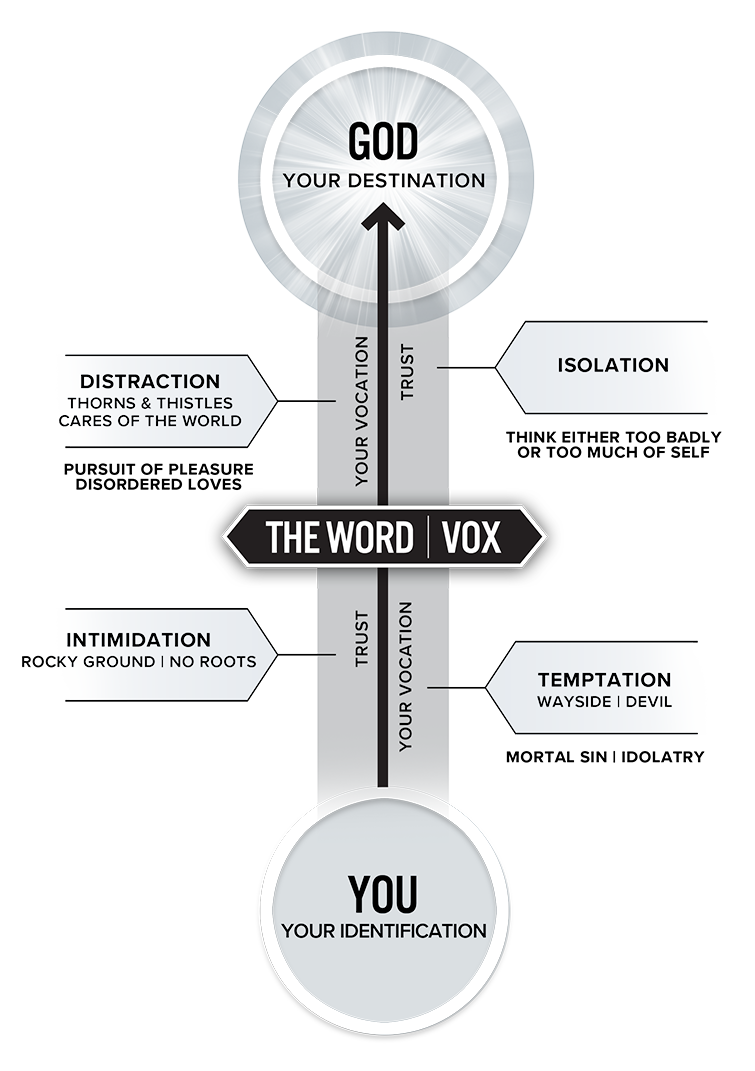
The evil one’s strategy can be described as having four aspects or stages: temptation, intimidation, distraction, and isolation.
The first stage is temptation.
If the evil one cannot tempt you or keep you in mortal or ongoing venial sin, he will use intimidation to drive you from your vocational path.
If he cannot intimidate you, he will use the tactic of distraction; and if he cannot distract you from your vocation, he will lure you into isolation.
The essence of this truth is disclosed by Jesus in the Parable of the Sower and the Seed.
Jesus interprets the birds that steal the seed sowed on the wayside as the devil who robs us of the seed of the Word, the voice of God, which speaks of our identity, mission, and destiny.
The evil one robs us of the seed before it can take root by means of temptation.
When a man is bound by such temptations, he cannot hear the Word nor is he truly capable of transmitting it to his wife and children.
If the devil cannot lead you into temptation, he will try to intimidate you.
Jesus said that the seed that fell on rocky soil and was scorched by the sun because it had no roots symbolizes those who initially believe, but when they are persecuted or experience suffering because of their belief in Jesus, lose heart and fall away.
If the evil one cannot tempt us or intimidate us, he will distract us.
Jesus said the seed that began to spring up was choked by thorns and thistles, which symbolize the pursuit of pleasures and riches, and the cares of the world.
The evil one derives great pleasure in giving us something good for the purpose of keeping us from that which is greatest.
Money, entertainment, relaxation, hobbies, and pleasure are all good, but if they rob your attention from God, your wife, and children, they become an obstacle to the success of your vocation.
If he cannot lure us with temptation, intimidation, or distraction, the devil will use the tactic of isolation.
Isolation occurs when we separate ourselves from people because we don’t believe them to be as holy as we are.
By doing this we separate ourselves from God.
The name “Pharisee” actually means separated one.
Isolation also occurs when we separate ourselves from God because we don’t believe that we are holy enough, and consequently we separate ourselves from His people.
Consider St. Joseph. When he discovered Mary pregnant without his cooperation, he initially withdrew from his vocational path and decided to separate himself from Mary.
The evil one attempted to intimidate and tempt St. Joseph to believe that he was not worthy of Mary—or God within her—in order to drive him into isolation.
Joseph, rather than isolating himself from God, placed himself in prayerful silent solitude with God.
It was in the silent solitude that Joseph received the Vox, the Word, the voice that communicated his identity and mission: “Joseph, son of David, [this is his identity: he is a son of David and therefore a son of God], do not fear to take Mary your wife, for that which is conceived in her is of the Holy Spirit [this is his vocation: to be a husband to the Mother of God and a father to the Son of God].” (Matthew 1:20).
Remain strong like Joseph.
Do not give the devil permission to drive you from your vocational path.
By following St. Joseph’s heroic example and relying upon his intercession, you can overcome temptation, intimidation, distraction, and isolation and become a great father who by means of discovering your identification in your vocation will lead your family to their destination, which is their glorification—their deification.

Devin Schadt | Executive Director of the Fathers of St. Joseph
Ite ad Joseph
Related Resources
Related Articles