


Devin Schadt / October 20th, 2025
The Path Series | #106
1338 words / Read Time: 12 minutes
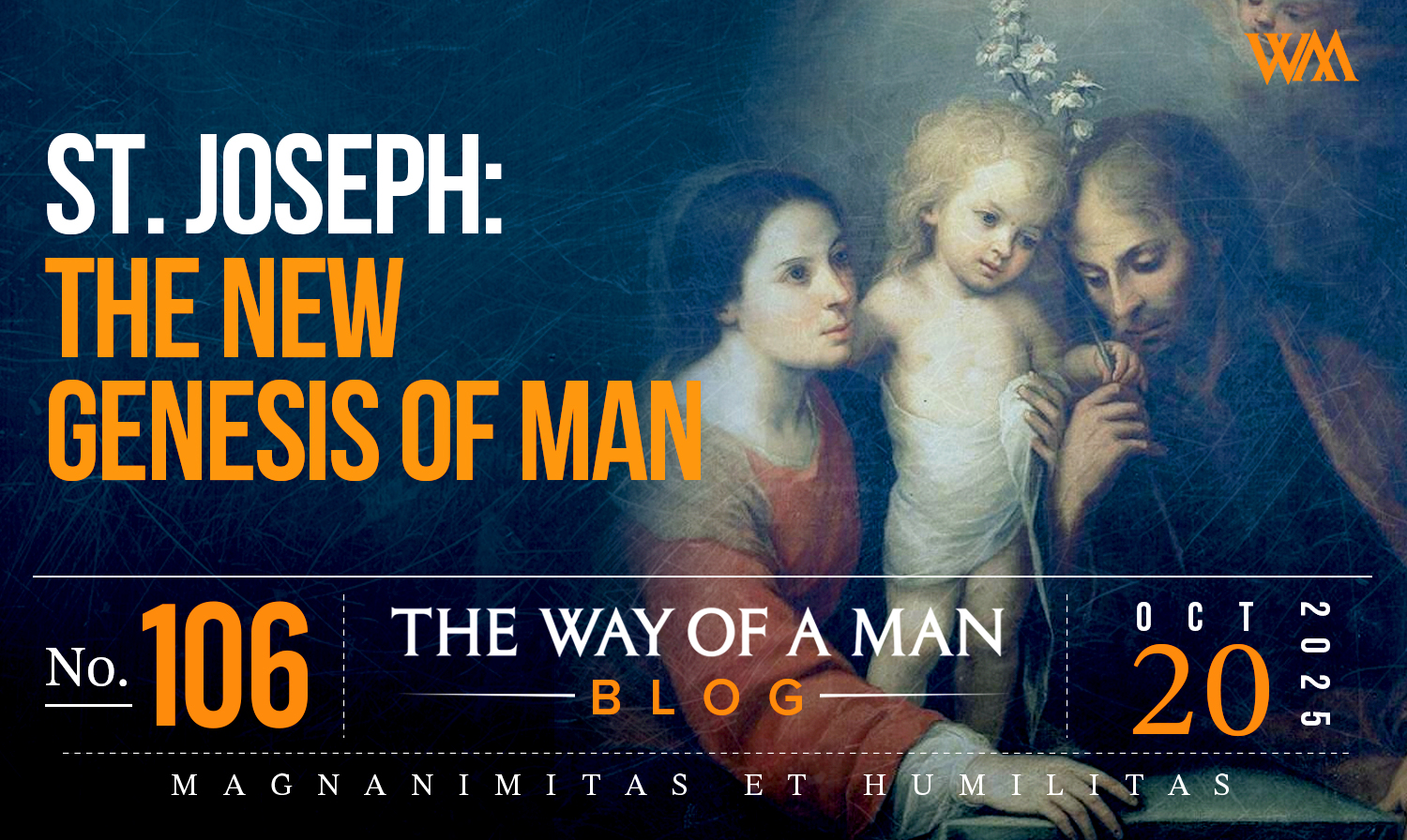
St. Joseph: The New Genesis of Man
St. Matthew’s Gospel begins with the words “the book of the origin of Jesus, the Son of David, the Son of Abraham” (Mt 1:1, emphasis added), and “now the origin of Christ was in this wise” (Mt 1:18, emphasis added). The word origin, used in both verses to describe the beginnings of Jesus, is the English rendering of the Greek noun genesis. By using the word genesis, Matthew is echoing the original creation account, connecting man’s beginning in Adam to the new beginning of men in St. Joseph, “the father of Jesus.”14
Later, in the first chapter of St. Matthew’s Gospel,15 we discover more convincing evidence of the Evangelist’s intention to proclaim a “new beginning,” a New Genesis in the marriage of Joseph and Mary.
So all the generations, from Abraham to David, are fourteen generations. And from David to the trans- migration of Babylon, are fourteen generations: and from the transmigration of Babylon to Christ are fourteen generations. Now the generation of Christ was in this wise. —Matthew 1:17-18
Matthew relates that the history of God’s people preceding Jesus Christ was comprised of three sets of fourteen generations. In other words, six sets of seven generations. Each of these six sets symbolize the original genesis account consisting of six days of creation.16
The generation of Christ within the marriage of Mary and Joseph constitutes the seventh generation, a symbol of the seventh day in the Genesis creation account in which God covenants (oaths) Himself to mankind.
Though the original covenant was repeatedly broken by God’s people throughout the six sets of seven generations, nevertheless God remains faithful to His people by establishing a New Covenant of eternal sonship in Jesus Christ. Thus, the seventh set of the seven generations symbolizes a completion in God’s creation and redemption of His people as marked by the seventh day in the creation account.
It is very likely that St. Matthew is drawing a correlation between Adam and Eve, who were appointed to become a bridge between the generations occurring on the sixth day (that of the beasts) and the covenant made on the seventh day (that of divine sonship), and St. Joseph, a New Adam, and the Blessed Virgin Mary, the New Eve.
This holy couple successfully bridges. The six sets of generations of God’s people to the seventh, final, and eternal generation of divine sonship won by Jesus Christ.
This concept of a new beginning, a new order of grace, a New Genesis in the holy virginal couple of Mary and Joseph, also appears to be a key theme in the Gospel of St. Luke:
Now in the sixth month the angel Gabriel was sent from God to a town of Galilee called Nazareth, to a virgin betrothed to a man named Joseph, of the house of David, and the virgin’s name was Mary. —Luke 1:26–27
It appears that St. Luke is intentionally, artistically, and, with rich symbolism, portraying the actual historical event of the Annunciation as an account of a new creation. The phrase “in the sixth month” echoes and typologically fulfills the creation account in Genesis wherein on the sixth day three things of tremendous import occur: first, the sinless, virgin Adam was created; second, it was from Adam that God formed the virgin woman and gave her being; and third, the couple entered into a covenant with God and one another.
The sixth month of Elizabeth’s pregnancy symbolizes the sixth day of creation in which man is created with the animals, and yet he is also created for the seventh day. This seventh day of rest is the day in which God vowed Himself to man; and man, expressed by his rest in God, vowed himself to God.
Again, man moves from the sixth day, the day of the beast (the mark of the base animal) to the seventh day, the day of divinization, the Day of the Lord.
The event of the Annunciation during the “sixth month” marks a pivotal transition, a turning point for fallen humanity that has repeatedly chosen to live as a base animal—bound by its fleshly passions and the seduction of sin—rather than as a transformed and divinized child of God.
In Mary’s womb, during the sixth month of her cousin Elizabeth’s pregnancy, the sinless, virgin, New Adam, Jesus was created. This new beginning echoes the original beginning in reverse: rather than Eve being formed from Adam, the New Adam is formed from the sinless New Eve.
Notice that these divine actions occur after Mary is betrothed to Joseph. Only after Mary and Joseph entered into a covenant with God and with one another by means of the first stage of Jewish marriage, the betrothal, does God grant the conception of the Word made flesh within the Virgin’s sacred womb.17
The significance of this truth cannot be overstated. Hence, St. Matthew records the angel’s words to Joseph during the dream of his own annunciation, “Do not fear to take Mary thy wife” (Mt 1:20 emphasis added).
The impact and effect of this truth has been eclipsed and restrict-ed by an erroneous translation of Mary’s response to the angel: “How can this be, since I have no husband.”18 Mary’s response to the angel is literally “How shall this happen, since I do not know man.” Her words indicate that she did not have sexual intercourse with Joseph, or any man for that matter. Her response can also imply that she is “full of grace,” that is, set apart from fallen humanity. The biblical meaning of the word know indicates the idea of intimacy. Mary not knowing man indicates that she is unlike mankind because she has no intimate subjective experience of the effects of sin.
The translation, “How can this be, since I have no husband,” is a misinterpretation at best, or a perversion at worst, that deprives St. Joseph of his vocational mission and unique role in the plan of salvation.
St. Joseph was her husband at the moment of the conception of Jesus, and therefore he is the father of Jesus 19 Moreover, by excluding St. Joseph from his proper role as the icon of God the Father, a subliminal message is communicated, namely that the human father’s participation in the family, as symbolized and embodied by St. Joseph, is viewed as ancillary, or worse as unneeded.
Nevertheless, the fact that the conception of the Word made flesh occurred after Mary and Joseph’s betrothal testifies and proclaims that God intentionally desired that His Son be conceived and born within the context of a virginal marriage.20
Why are these reflections on the New Genesis so important to the individual modern man? God willed that the Son of God would be conceived within the marriage of Mary and Joseph, making Jesus the spiritual Son of Joseph, and Joseph an icon of God the Father to Jesus.
By doing this, God is stating his will and intention: just as St. Joseph is an icon of God the Father to Jesus, so also, we fathers are called to be icons of God the Father to our children.
You, my brother, are summoned by God to be a living symbol of his fatherhood, to be a father who exercises and exemplifies the paternal authority of God the Father.
Marriage and the family are not only the foundations of society, but they are the very context in which you, as a man, will learn to love authentically. By responding to the responsibility to be the father and husband within your family, you will ascend from the beasts of the sixth day to the realm of divine sonship of the seventh day, which is marked by communion and intimacy with God.
Your fatherhood, and the way you understand it, embrace it, and live it, is divinely designed to reflect the presence of God the Father’s loving authority to your family and the world. This noble responsibility is of the greatest importance and will afford you the true significance for which every man longs.
14 “Jesus . . . being (as it was supposed) the son of Joseph.” Lk 3:23. 15 See Mt 1:17.
16 See Gn 1.
17 St. Augustine said, “Here is another of [the heretic’s] calumnies, ‘Through Joseph,’ they say, ‘the generations of Christ are counted, and not through Mary.’ ‘This should not have through Joseph,’ they say. Why not through Joseph? Was not Joseph Mary’s husband? ‘No, they say.’ Who says so? For Scripture says on the authority of an angel that he was her husband.’” Joseph and Jesus: A Theological Study of Their Relationship, p 38.
18 This error is contained in many translations including Young’s Literal Translation, Wymouth New Testament, and the Revised Standard Version.
19 St. Augustine, defending St. Joseph’s fatherhood said, “Just as this was a marriage without deordination, should not the husband have accepted virginally what
the wife virginally brought forth? For just as she was virginally the wife, so was he virginally the husband; and just as she was virginally the mother, so was he virginally the father.” And again, “Let his greater purity confirm his fatherhood. . . . We should count through Joseph, because as he was virginally the husband, so was he virginally the father.” Joseph and Jesus: A Theological Study of Their Relationship, p 40.
20 Analyzing the nature of marriage, both St. Augustine and St. Thomas always identify it with an “indivisible union of souls,” a “union of hearts” with “consent.” These elements are found in an exemplary manner in the marriage of Mary and Joseph. At the culmination of the history of salvation, when God reveals his love for humanity through the gift of the Word, it is precisely the marriage of Mary and Joseph that brings to realization in full “freedom” the “spousal gift of self” in receiving and expressing such a love. “In this great undertaking, which is the renewal of all things in Christ, marriage—it too purified and renewed—becomes a new reality, a sacrament of the New Covenant” (RC, 7).

Devin Schadt | Executive Director of the Fathers of St. Joseph
Ite ad Joseph
Related Resources
Related Articles