


Devin Schadt / February 26th, 2026
The Way of a Man Series | #126
1951 words
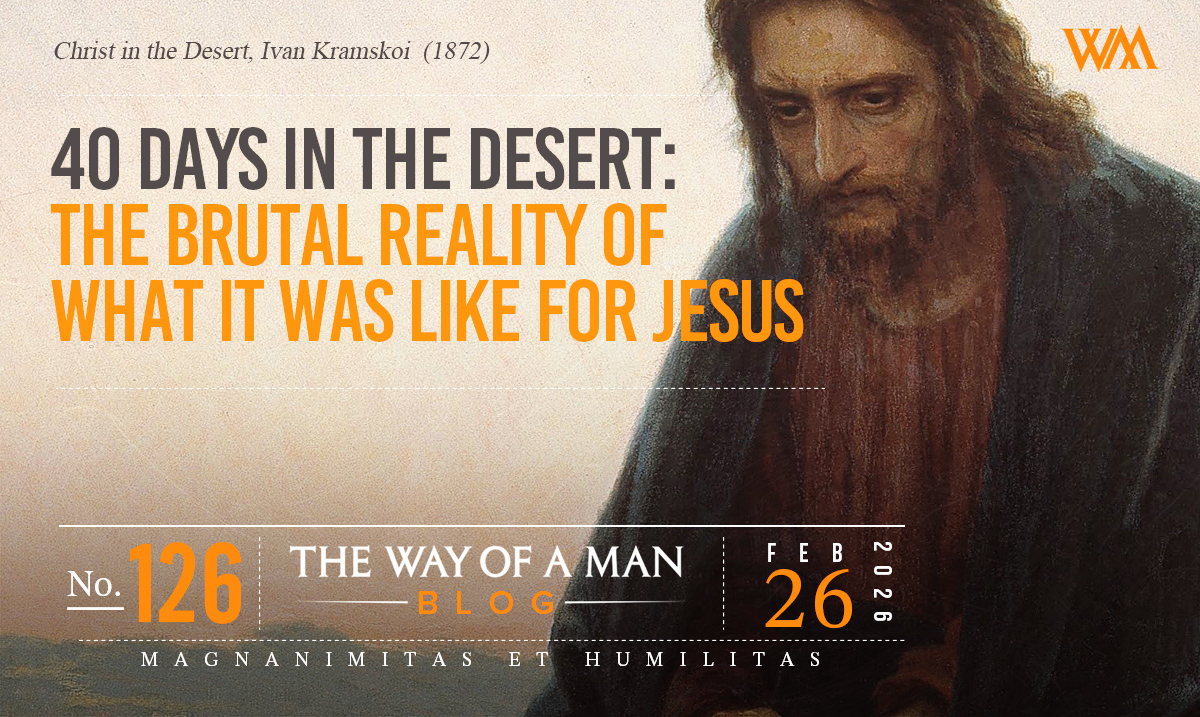
40 Days in the Desert: The Brutal Reality of What It Was Like for Jesus
What was Jesus’ Desert Fast Really Like?
Matthew, Mark, and Luke recount Our Lord Jesus’ desert fast forty-day excursion into the desert wilderness.
We are told that after the duration of the fast, “Jesus was hungry.”
Understatement.
With tremendous lameness (if that is even a word), parishes across the world attempt to convey this “hunger” and Jesus’ “desert” experience with blankets of burlap folded elegantly beneath cactuses and thorns; a deprivation of holy water (which is a satanic deprivation of spiritual ammunition and defense against the enemy); and other palpable visuals connoting aridity, with the purpose of sparking a connection between Our Lord’s sacrifice for us and our Lenten sacrifices for Him. These feeble reminders, however good the intention behind their implementation may be, do not come anywhere close to connecting us with Our Lord’s desert experience.
This Lent, as I reflect on the question, “What could I offer Christ that would demonstrate my love for Him?” I inevitably ask another question: “What did Jesus do for me?”
My tendency is to proceed directly to the last three days of Our Lord’s life and meditate on His Passion, crucifixion, and the sheer horror and intrusive acute pain that fell upon Christ.
But what was His experience in the desert like?
Full disclosure: I did ask ChatGPT (Try not to judge me):
“Provide a biological, scientific, psychological, neurological analysis of the effects of a forty-day fast on the human person… then proceed to provide the consequences of living in the desert for forty days and nights, unshielded from the elements.”
The synopsis grants us a glimpse into Jesus’ acutely intense desert testing.
In fact, acutely intense is a massive understatement.
Our Lord’s venture into the desert was nothing less than an endeavor to push Himself to the very edge of horror, pain, cognitive dysfunction, and perhaps the worst type of death.
Outlining the Effects of Jesus’ Desert Fast
- First, I would like to outline (per ChatGPT) the destructive effects of not eating for forty days by describing the metabolic breakdown in four stages: days 0–2 / days 2–10 / days 10–30 / days 30–40.
- Second, the distressing and disturbing neurological and psychological effects on a person who fasts for forty days.
- Third, the devastating consequences on a person’s hormonal and immune systems.
- Fourth, the possibility of survival.
After we have painted the picture of the human person after forty days of fasting, we will outline the effects of living in the desert for forty days—unshielded.
1. Metabolic Phases (What the Body Actually Does)
Days 0–2: Glycogen Depletion
- Liver glycogen (stored glucose) is exhausted within approximately 24 hours.
- Blood sugar begins to fall.
- Hunger hormones (ghrelin) spike sharply.
- Irritability, headache, weakness.
Days 2–10: Ketosis & Metabolic Shift
- Body switches to fat oxidation, producing ketone bodies.
- Brain adapts to ketones (reducing—but not eliminating—glucose needs).
- Insulin drops; cortisol and glucagon rise.
- Hunger often fades, replaced by a flat, hollow sensation.
- Noticeable weight loss (water, fat, and some muscle).
Days 10–30: Protein Catabolism
- Fat stores diminish; the body increasingly breaks down muscle and organ tissue for amino acids.
- Loss of skeletal muscle, then cardiac and respiratory muscle.
- Immune suppression becomes significant.
- Cold intolerance, dizziness, orthostatic hypotension.
Days 30–40: System Failure Territory
- Electrolyte imbalance (especially potassium and sodium).
- Risk of fatal arrhythmias.
- Severe muscle wasting.
- Edema may appear despite starvation (low albumin).
- Refeeding at this stage becomes medically dangerous (refeeding syndrome).
2. Neurological & Psychological Effects
Early
- Heightened alertness (stress hormones).
- Intrusive thoughts about food.
Mid-fast
- Emotional flattening or detachment.
- Slowed cognition, impaired judgment.
- Altered time perception.
Late
- Apathy, confusion, dissociation.
- Reduced pain perception.
- Possible hallucinations or delusional thinking due to electrolyte and glucose instability.
3. Hormonal & Immune Consequences
- Testosterone, estrogen, and thyroid hormones drop.
- Cortisol remains chronically elevated.
- Immune cell production declines; infection risk skyrockets.
- Wound healing slows dramatically.
4. Survival Reality
Forty days without food is survivable for some, but:
- It depends on initial body fat, hydration, electrolytes, and rest.
- Mortality risk rises sharply after approximately thirty days.
- Long-term damage (heart muscle, metabolism) is common.
Deathly Consequences of the Forty-Day Fast
In other words, a person who fasts for forty days is on the brink of bodily failure and psychological breakdown.
He has experienced severe muscle atrophy, particularly of his cardiac and respiratory muscles, and will most likely suffer from fatal heart arrhythmias.His immune system has been greatly compromised, rendering him vulnerable to infection, and he has experienced hormonal collapse.
He has impaired judgment, emotional flattening, altered perception of pain, reduced response to danger, and lacks the capacity to preserve and protect himself. He is on the verge of fatality.
This was Jesus.
Into the Desert
Now, if we place that person—fasting for forty days—into the context of the desert, he will encounter additional stressors that compound his trauma.
1. Thermal Stress (Heat by Day, Cold by Night)
Daytime
- Core temperature rises.
- Profuse sweating leads to rapid dehydration.
- Electrolyte loss causes cramps and confusion.
- Heat exhaustion progresses toward heat stroke.
Nighttime
- Desert temperatures can drop 30–50°F.
- Hypothermia becomes possible due to depleted fat and glycogen.
- Shivering becomes inefficient over time.
2. Dehydration & Renal Stress
- Even mild dehydration (>2%) impairs cognition.
- Chronic dehydration leads to kidney injury.
- Risk of rhabdomyolysis (muscle breakdown releasing toxins into the bloodstream).
- Urine output drops; toxins accumulate.
Without reliable water, survival rarely exceeds three to seven days—not forty.
3. Neurological & Psychological Effects
Early
- Heightened vigilance (fight-or-flight).
- Anxiety, irritability.
Mid-exposure
- Sleep deprivation due to temperature swings.
- Circadian rhythm disruption.
- Impaired executive function.
Late
- Disorientation, paranoia.
- Hallucinations (sensory deprivation combined with dehydration).
- Reduced fear response—dangerously so.
4. Skin, Eyes, and Immune Damage
- Severe UV exposure leads to burns and DNA damage.
- Corneal injury may result in temporary or permanent vision loss.
- Skin barrier breakdown increases infection risk.
- Immune suppression from stress and malnutrition.
Fatal Consequences
The probability of survival is slim to none.
Primary causes of death include heat stroke, dehydration, renal failure, and electrolyte collapse. Psychological breakdown often precedes physical collapse.
When the forty-day fast is set within the context of the desert, systemic failure occurs:
Homeostasis — the body cannot maintain internal balance.
Electrolytes — tiny imbalances cause catastrophic outcomes.
Judgment — the brain loses the ability to assess risk accurately.
Identity & Motivation — prolonged deprivation strips away higher-order thinking.
What remains is not strength or weakness, but bare survival physiology.
Moreover, Mark recounts that “He was with the beasts” (Mark 1:13), indicating that while in His weakest neurological, psychological, and physical state, Our Lord had to defend Himself from carnivorous jackals, hyenas, wolves, and perhaps the Syrian brown bear that were intent on devouring Him for dinner.
Why Did Jesus Do It?
St. Matthew tells us, “Then Jesus was led by the Spirit into the desert, to be tempted by the devil” (Matthew 4:1).
Mark says that “the Spirit drove Him out into the desert” (Mark 1:12).
God drove Jesus into the desert for the purpose of testing, which involves overcoming temptation.
Our Lord intentionally, disregarding any form of self-preservation, launched into a battle with death itself.
Jesus purposefully took His entire human person to the edge of physical and psychological fatality in order to learn how to overcome the enemy in His lowest and most vulnerable state.
His purpose was to prepare Himself for His public ministry, which would demand everything from Him, including His three-day imprisonment, bodily and psychological torture, and His brutal crucifixion and death on the Cross.
If He could defeat Satan while at His weakest in the desert, He could endure His ultimate sacrificial offering when He would again be in His most vulnerable state.
How the Desert Experience Prepared Christ
Consider several key moments of Our Lord’s ministry that could have caught Him off guard—and perhaps overcome Him—had He not trained and prepared Himself in the desert.
After the feeding of the multitudes, the crowds desired to carry Him off and crown Him king (see John 6:15).
In the desert, Christ—while enduring His lowest cognitive functional level, while experiencing hallucinations and disorientation—withstanding Satan’s offer: “Bow down to me, and I will give you the kingdoms of the world” (see Matthew 4:8–9; Luke 4:5–8).
Jesus rendered Himself capable of overcoming the temptation to be crowned king of Israel because He had already, while His defenses were lowest, overcome the temptation to be “lord and prince of the world.”
Later, after being with the multitudes for over three days, the scribes and Pharisees demanded that Jesus perform a sign to prove that He was the Son of God (see Matthew 12:38; 16:1–4).
Jesus, while in the desert—unshielded and severely famished to the point of muscular atrophy and malnutrition—was prompted by the devil to turn stones into bread. The devil goaded Him to prove that He was the Son of God by means of a miracle.
Yet Jesus, in a sense, said to the devil, “I do not have to prove Myself to anyone—especially you—because I am confident in My identity as the Son of God the Father.”
Jesus’ ability to maintain His confidence in the Father and His identity as Son—without succumbing to proving Himself—prepared Him to overcome with ease the temptation to prove His divine identity to the Jews.
Jesus could have fled the desert experience. He could have stopped His fast. He could have given Himself reprieve. He could have appealed to comfort—but He did not.
Later, in the Garden of Gethsemane, praying to His Father that the chalice of ignominious suffering would pass, a cohort armed with clubs, torches, and swords demanded that Jesus surrender Himself to the religious authorities (see John 18:1–11).
His refusal to flee the desert test provided Jesus with the experiential strength and confidence that He could resist fleeing from those who came to capture Him.
I could provide a multitude of examples—you get the idea.
Desert Training — Essential for the Christian Man
So, what is the point?
Are you and I allowing the Holy Spirit to drive us into the desert to be tested—and yes, even tempted?
Are you and I intentionally choosing sensual deprivation, or are we succumbing to comfort?
At every turn, amidst every trial and test, during every fast and personal mortification, the evil one and his minions will offer an easier, more comfortable way out. If we choose comfort over sacrifice, when the time for real sacrifice comes, we will not be capable of loving Christ, for we have consistently loved ourselves first.
You and I are called to spiritual boot camp with the Holy Spirit.
The Holy Spirit is looking for a few good men willing to follow Jesus into the desert experience and deny comfort for the sake of becoming a sacrificial offering to God.
Call to Action
The call to action is extremely simple:
Whenever and wherever you are, choose discomfort over comfort.
For example:
- Instead of a second helping, remain content with a single serving.
- Drink water when you want a soda.
- Refrain from using salt when the meal is bland.
- Deprive yourself of warm water in the shower.
- Instead of turning to social media when bored, turn to God and your family.
- Instead of hitting the snooze button, rise immediately.
Choose discomfort, and you will gain the divine comfort of knowing that you are becoming a true son of God the Father.
Indeed, by removing comfort, you make room for Him to dwell within you.
Acquiescing to comfort has consistently offered me short-term consolation, but also the long-term desolation of knowing that I am pathetic and lack love for my Lord and Savior.
It is in conquering short-term consolation that I begin to experience enduring peace, knowing that I am choosing Him above myself, making a home for Him within me, and becoming capable of proclaiming with the holy apostle Paul, “It is no longer I who live, but Christ who lives in me” (Galatians 2:20).
Endnotes/Resources:
https://www.vatican.va/archive/ENG0015/__P1E.HTM
Catechism on Christ’s temptation

Devin Schadt
Executive Director | The Fathers of St. Joseph
Related Resources
Related Articles