


Devin Schadt / October 21st, 2026
The Way of a Man Series | #142
1630 words
“How Do I Know If I Am a Real Man?”
“How do you know when you’re a man?”
Recently, I met with a young man in his late twenties.
At first glance, he has it all.
He is handsome.
Physically strong and has successfully built a lucrative business.
Yet, during our conversation, he muttered, “How do you know when you are a man?”
Women would not understand that question.
No woman asks, “Am I a real woman?”
But nearly every man asks, at some point in his life (or many points), am I a man—a real man?
According to the Institute for Family Studies, approximately 70% of men say that manhood is harder to define than it was decades ago, and many say they feel “stuck”, unsure whether they’ve truly reached adulthood.

Do Initiation Rites Make a Boy a Man?
The fundamental disquiet that rumbles like background noise in a young man’s soul has traditionally sought an answer to manhood through contrived initiation rites.
These rites, challenging and often macabre, center on conquering pain and fear.
Only after you’ve spent the night, blindfolded, strapped to a tree in a jungle, without being mauled by a predator (very important qualification); or have left the village in a coffin only to return to the village and rise from it, or have endured the bullet ant rite (learn more here), you have mysteriously bridged that fissure that separates the boys from the men.
The defining and noble element of these initiation rites was to prepare the young boy with the confidence to provide and protect—even at the cost of himself.
Do Enduring Pain and Fear Make a Man a Man?
There is no doubt that the conquering of fear and pain is essential to masculine growth, but it is also a shallow requirement for manhood.
Burn your hand.
Wreck your motorcycle.
Break a bone.
Fight in the ring (or outside of it).
Jump off a cliff.
Skydive.
Swim with sharks.
Tread water in the Mississippi.
If you endure them, you have magically hurdled the gap from boyhood to manhood.
What Makes a Real Man? The Four Stages of Manhood.
The defining factor of a proper initiation rite is that the element of pain and fear serves the greater purpose of learning self-donation.
Taking on fear and pain without having a transcendent purpose is incapable of obtaining manhood.
Self-donation defines manhood.
Without this key characteristic, you miss manhood.
No single moment marks your arrival at manhood.
It is an arduous, grinding, soul-wrenching process that involves four stages of growth, patterned after Christ Himself.
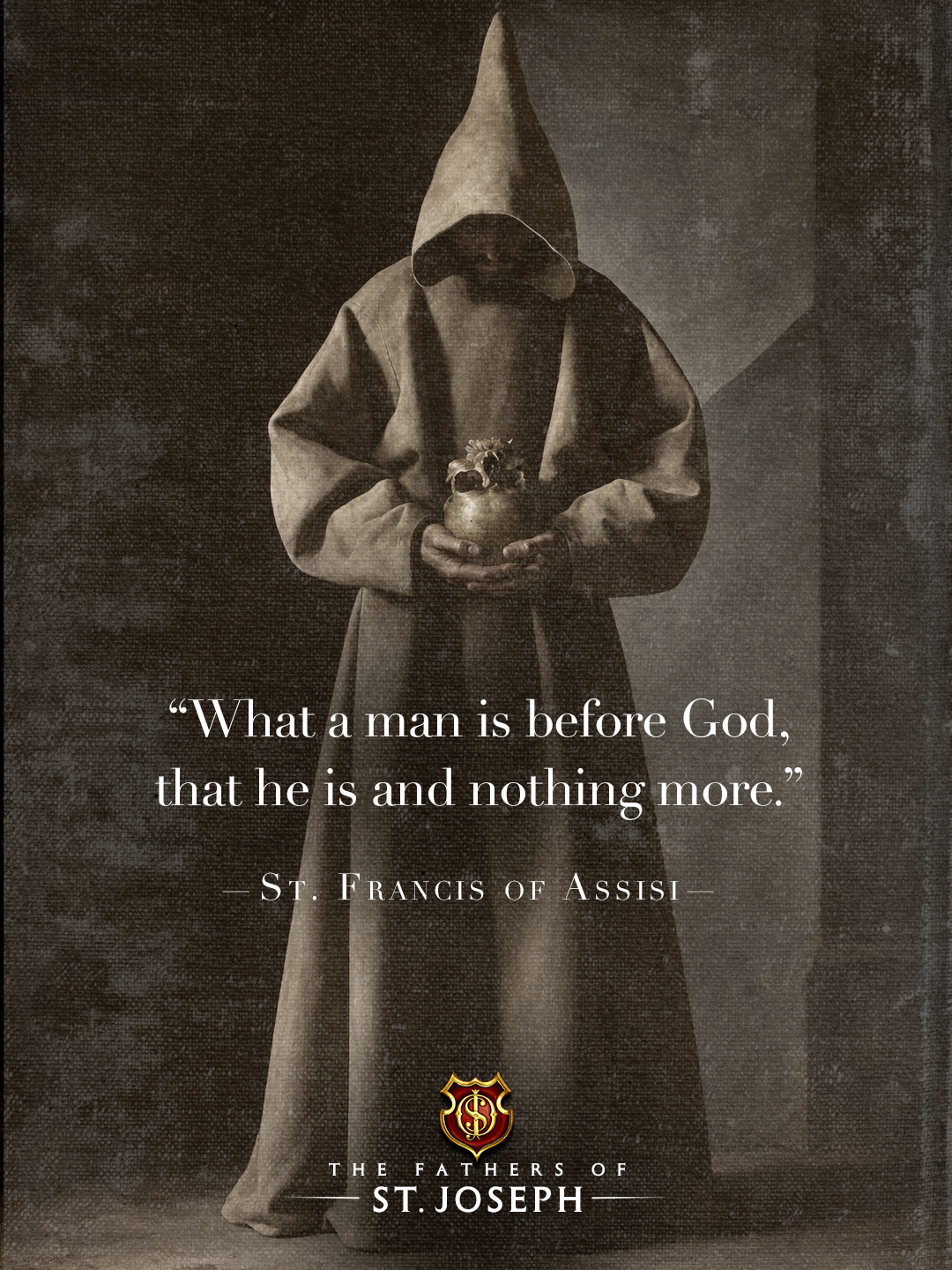
As St. Francis of Assisi said,
“What a man is before God, that he is and nothing more.”
The Four Stages of Manhood
Stage 1: Nazareth: Building Trust in God the Father Through Work
The question the aspirant asks during this stage is: Is God good? Will He come through for me? Will He be a gift?
This is the period where the boy who resists pain and labor learns to work and works to learn. He discovers that work is a blessing.
As St. Jose Maria Escriva said,
“Work is man’s original vocation. It is a blessing from God, and those who consider it a punishment are sadly mistaken.”

He allows himself to be mentored and becomes an apprentice.
As an apprentice, he develops his skill sets and cultivates his talents.
Labor becomes a way of life, a creative outlet, and, most of all, a way to be a gift to the world around him.
Through his labors, he overcomes the fear of failure and conquers bodily pain and fatigue.
However, the key factor in the lad’s development during this stage is inviting God the Father into his work.
This stage helps the boy develop a relationship with God the Father.
Again, to quote St. Jose Maria Escriva.
“Sanctifying one’s work is no fantastic dream, but the mission of every Christian—yours and mine.”

Inviting God Into Your Work
In his labors, he asks God for His guidance and His blessing.
By working with God the Father, he learns to trust Him through his work.
In the humble Nazareth workshop, St. Joseph mentored Jesus.
Together, Joseph and Jesus crafted the cross of self-giving love.
Our Lord learned to work, sweat, endure pain, and overcome the fear of failure.
Joseph taught Jesus to invite the Father into every aspect of their work.
Stage 2: Baptism in the Jordan: Receiving the Call (Vocational Awareness)
This second stage is marked by questions like:
How can I be a gift? In what way? What does this look like?
During this stage, the aspirant continues to cultivate, hone, and evaluate his skills.
He asks himself, “How are these gifts to be put to use for others? What is my divine calling?”
Many men become confused at this stage.
They mistakenly believe their vocation is to be wealthy, famous, or influential.
Those are not callings per se.
They are not permanent relationships or vocations in which one lives for the service of the other.
What Is My Calling?
The aspirant invites God the Father to help him discern whether he is called to marriage, the priesthood, the contemplative life, or to use his gifts for the service of mankind as a single person.
“Discernment is the mother of all the virtues; everyone needs it either to guide the lives of others or to direct and reform his own life” (St. Baldwin of Canterbury, emphasis added).

His discernment is marked by prayer.
He asks deeper questions of himself and of God: Jesus, how can I follow you with my life?
As Christ rises from the waters of the Jordan, after John baptized Him, God makes the solemn pronouncement, “You are my beloved Son, with you I am well pleased.”
Then John the Baptist voices Jesus’ calling: “Behold the Lamb of God who takes away the sins of the world.”
Jesus knew that He was God’s Son, and therefore He could answer the call (the vocation) to sacrifice.
Stage 3: The Desert: Preparation for Mission
This preparatory stage answers the question: How do I possess my giftedness?
As St. Augustine said, “You cannot give what you do not possess.”
In this stage, the aspiring laborer, knowing he is a son of God the Father, learns to possess himself.
This is a time of testing, marked by passive and active sufferings.
God will test his son through trial, peril, and suffering.
His endurance of the previous two stages has given him certainty of God’s goodness and that God has called and chosen him; therefore, he embraces these tests with trust in God.
The aspirant will test himself by practicing mortification, penance, prayer, and almsgiving.
He pushes his physical limits for a spiritual purpose.
His purpose is clear: to accomplish God’s will.
During those forty days and nights in the desert, Jesus mastered his flesh through fasting and prayer so he could fully possess it and offer it for us and our sins.
Creating Your Own Desert Experience
Like Christ, we launch out into the spiritual desert.
This was His “initiation rite,” and it is ours.
We craft our own desert experience by submitting ourselves to a holy confessor or spiritual director.
We attend silent retreats.
Establish a prayer schedule.
Create a chapel in our home.
These become our desert.
At this stage, the aspiring man becomes well ordered.
He has developed his own rule of life, consisting of daily prayer times, fasting days, and a Eucharist-centered life.
Through penance, he comes to possess his very self and can therefore give himself away in service to and for others.
He heeds the Scripture:
“You have not avoided sin to the shedding of your blood.” (Hebrews 12:4)
“Offer your body as a holy and living sacrifice unto the Lord.” (Romans 12:1)
Indeed, as St. Ambrose wrote:
That man is rightly called a king who makes his own body an obedient subject and, by governing himself with suitable rigor, refuses to let his passions breed rebellion in his soul, for he exercises a kind of royal power over himself. And because he knows how to rule his own person as king, so too does he sit as its judge. He will not let himself be imprisoned by sin, or thrown headlong into wickedness.
Stage 4: The Public Mission: Sacrificial Responsibility
During this stage, the aspirant decides, “This is how I will be a gift.”
He makes his vows to God through matrimony, the priesthood, or by using his talents to better humanity.
Like the anvil to the metal, this stage forges him into a true man through continual decisions to sacrifice for and serve others.
Whether as a priest, husband, father, consecrated celibate, or missionary, the true man is characterized by laying down his life and his own selfishness to be a gift to others. He is intent on following Christ.
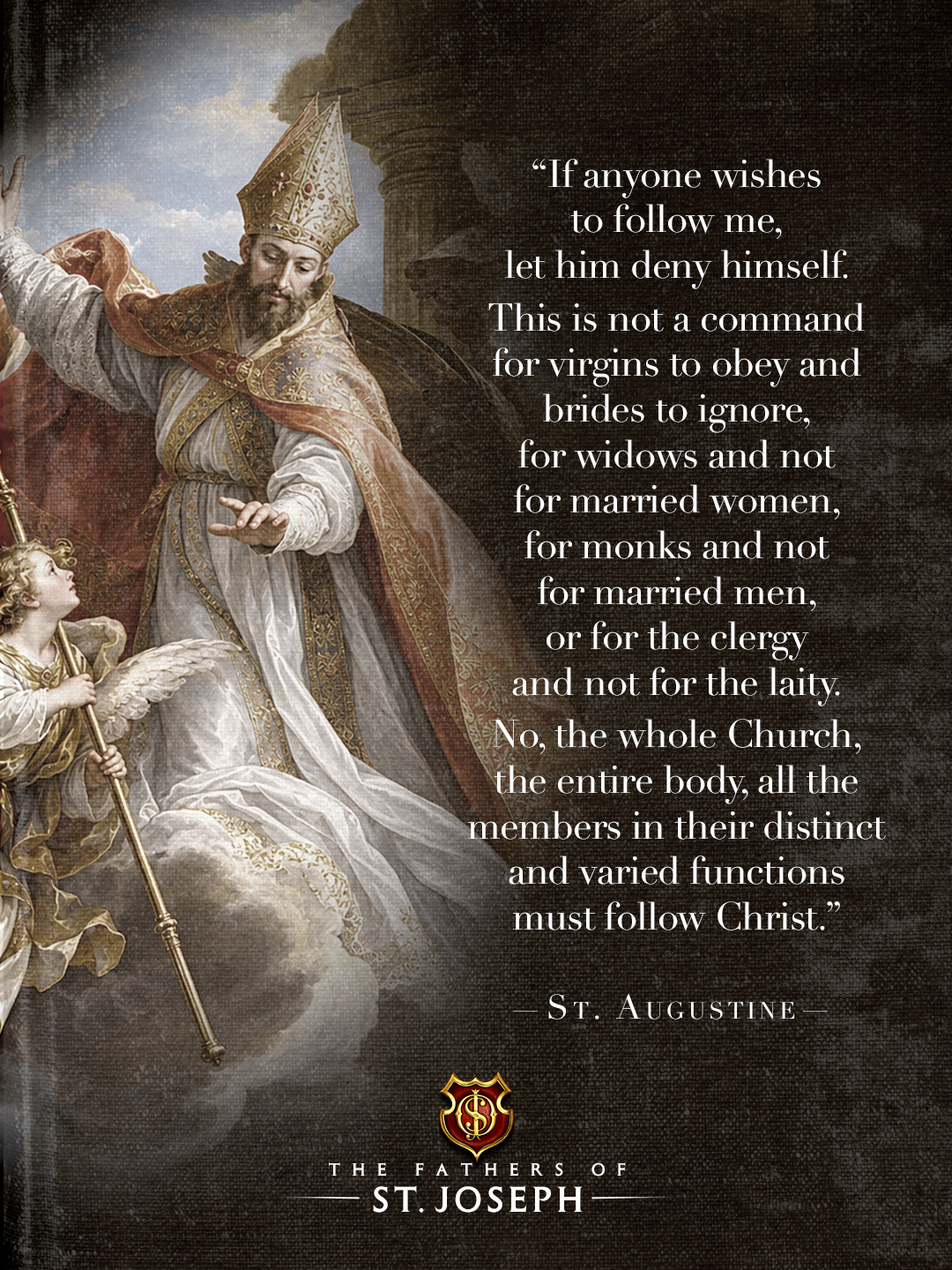
“If anyone wishes to follow me, let him deny himself. This is not a command for virgins to obey and brides to ignore, for widows and not for married women, for monks and not for married men, or for the clergy and not for the laity. No, the whole Church, the entire body, all the members in their distinct and varied functions must follow Christ.” (St. Augustine)
Being a Real Man is a Daily Decision
Each day, you and I choose to be men.
We do our work with excellence to glorify God and to be a gift to those around us.
As St. Paul says, we “Count others as better than ourselves.”
Indeed, “We bear their burdens as our own.”
As the days, weeks, months, and years transpire, our continual decision to be a man of God accumulates, “until we all meet in the unity of faith, and of the knowledge of the Son of God, unto a perfect man, unto the measure of the age of the fulness of Christ.” (Eph 4:13)
This is true manhood.
Do you want a joy-filled, trusting, intimate marriage?
Learn more and get your copy of:
The Marriage Gap: How to Understand, Communicate, and Meet Your Spouse’s 4 Deepest Needs

Devin Schadt
Executive Director | The Fathers of St. Joseph
Related Resources
Related Articles