



Devin Schadt / May 27th, 2025
The Way of a Man Series | #72
1035 words / Read Time: 10 minutes
Another Lamb of God?
Invocation: Jesus, reveal to me my sacred mission.
The Spiritual Life’s Sacred Mission:
“Behold the Lamb of God.” John 1:29
The two fundamental arms of the Christian man’s life are identity and mission.
So interdependent upon one another are these two that to neglect one would be to neglect the other.
For if a man knows not who he is, how can he know who he is to become?
If a man does not comprehend his identity in Christ as a son of God, how can he become like God’s Son, the Christ?
Unaware of his identity, he lacks a real sense of mission, never achieving his destiny.
Unaware of his destiny, he fails to undertake the mission demanded and dependent upon his identity.
Yet, by becoming more aware of who we are in Christ, we can receive the grace to become like Christ the Son.
Following Jesus’ baptism, after hearing God the Father’s solemn pronouncement, John the Baptist cried aloud, “Behold the Lamb of God” (Jn 1:29).
God proclaims His Son’s identity, while man announces God the Son’s mission—He is to be the Lamb of God.
Threaded throughout Israel’s salvation history is the reoccurring theme of the “Lamb of God.”
Abraham, commanded by God to sacrifice Isaac his son, his only son whom he loved (see Gen 22:2), is asked by Isaac as they climbed Mount Moriah, “Behold . . . fire and wood: where is the victim for the holocaust?” (Gen 22:7).
To which Abraham responded, “God will provide himself a victim” (Gen 22:8).
When the angel of God demanded that Abraham spare his son, the Scripture says, “Abraham lifted up his eyes, and saw behind his back a ram amongst the briers sticking fast by the horns, which he took and offered for a holocaust instead of his son” (Gen 22:13).
The lamb which God would provide had not yet been provided by God.
Approximately four centuries later, to manifest His power, and to liberate the Israelites from being enslaved by the Egyptians, God inflicted the Egyptians with the culminating tenth plague—the death of the firstborn (see Ex 11:1–12:36).
God, through Moses, commanded that every Israelite family procure a lamb “without blemish, a male, of one year: according to which rite also you shall take a kid” (Ex 12:5) and sacrifice the lamb, mark the doorposts and lintels of their dwellings with its blood (see Ex 12:7), and “eat the flesh that night roasted at the fire, and unleavened bread with wild lettuce” (Ex 12:8).
“And it came to pass at midnight, the Lord slew every firstborn in the land of Egypt, from the firstborn of [Pharaoh], who sat on his throne, unto the firstborn of the captive woman that was in the prison, and all the firstborn of cattle” (Ex 12:29), while the angel of death “passed over” the Israelites.
By means of the figure and symbol of the lamb, God established a profound correlation between the lamb and the firstborn son.
The lamb was the object of sacrifice that enabled the son, an object of affection, to be ransomed.
From Moses to Christ, over the course of the centuries, millions upon millions of lambs were sacrificed as a remembrance that God had spared His firstborn son, Israel, from slavery to Egypt and slavery to the sin of idolatry.
Nevertheless, Israel’s iniquity became so foul and depraved that an infinite number of sacrificial lambs could not cover the multitude of its sins. Israel was beyond ransom.
Indeed, “all we like sheep have gone astray, every one hath turned aside into his own way” (Is 53:6).
Yet, at the fullness of time, the true Lamb of God, the one who would take upon Himself the sins of the world (see Jn 1:29), was revealed: “And beholding Jesus walking, [John the Baptist] saith: Behold the Lamb of God” (Jn 1:36).
From all eternity it was God the Son’s will, in union with His Father, to fulfill the mission to be the Lamb of God upon whom the iniquity and the sin of mankind fell.
The mission of the Lamb of God was to sacrifice Himself for our transgressions: “And the Lord hath laid on him the iniquity of us all. He was offered because it was his own will” (Is 53:6–7, emphasis added).
In the person of Jesus, the Lamb and the Son become one.
He is the unblemished (sinless), male, sacrificial Lamb whose mission is to make atonement for men, but, as in the first Passover, we must partake of the Lamb’s flesh.
It is not satisfactory nor sufficient for us to express our gratitude with our lips, but we must do so with our lives.
Indeed, the praise that passes over our lips must be professed by our deeds.
As the psalmist asks:
“What shall I render to the Lord, for all the things he hath rendered to me?” (Ps 116:12). “I will pay my vows to the Lord before all his people: precious in the sight of the Lord is the death of his saints” (Ps 116:14–15).
In other words, Christ’s mission is not His exclusively; it also is the mission of the Christian.
Indeed, Jesus’ sacrifice has won for us the grace and honor to sacrifice for Jesus.
We have the privilege to participate in His sacrifice by offering our “bodies a living sacrifice, holy, pleasing unto God, your reasonable service” (Rom 12:1)—this is your true and proper worship.
It is our privilege “not only to believe in him, but also to suffer for him” (Phil 1:29).
For this reason, St. Paul can conclude that “for [his] sake we are put to death all the day long. We are accounted as sheep for the slaughter” (Rom 8:36).
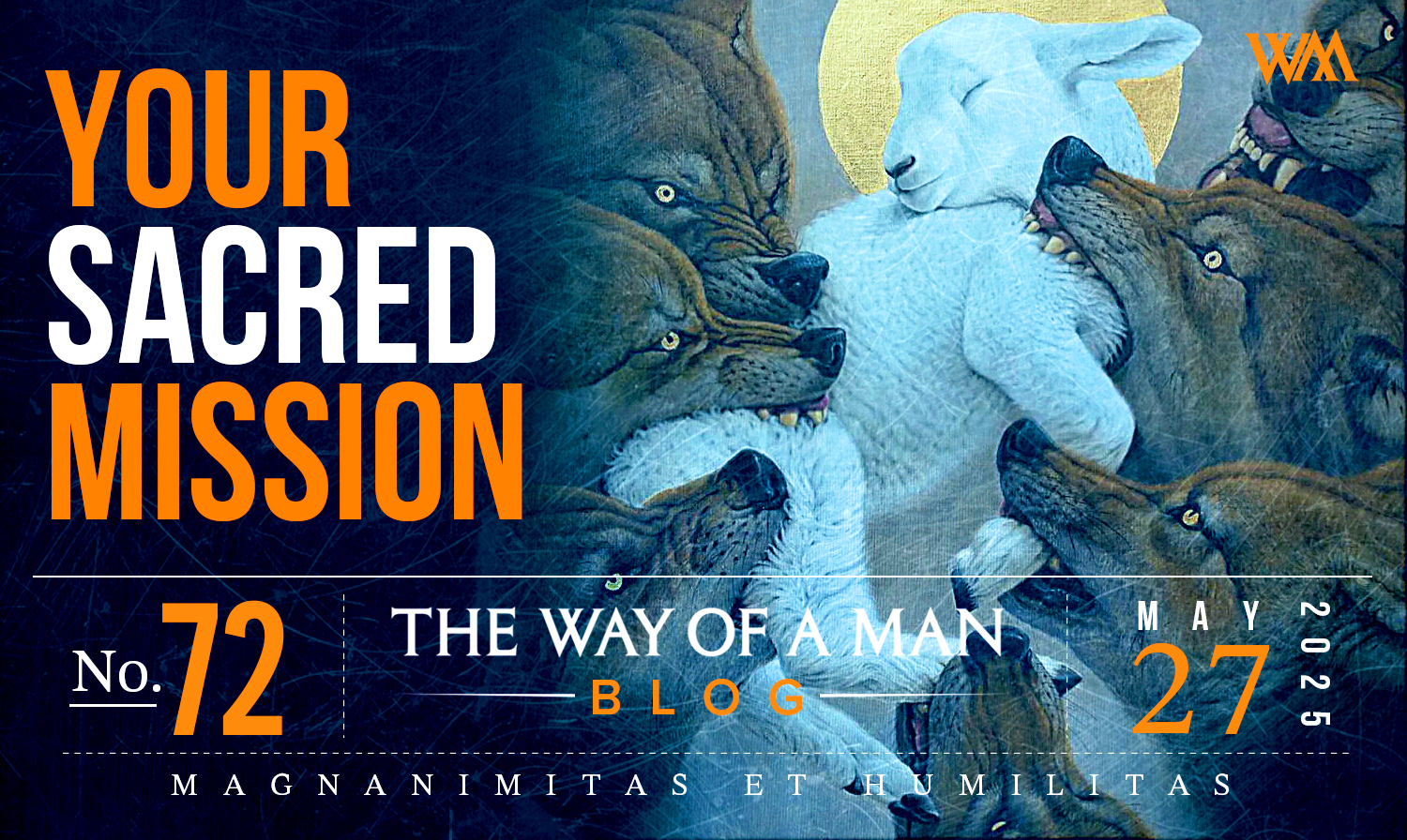
It is a great paradox that to be privileged in Christ is to become a sacrificial lamb.
If a man be a true son of God, he is to become another lamb of God.
The mission of a son of God is to be one with the Lamb of God and His mission.
By means of your self-sacrifice, in union with Christ’s sacrifice, you will become capable of transmitting God’s divine life to others. This is your mission.
“For unto this are you called: because Christ also suffered for us, leaving you an example that you should follow his steps” (1 Pt 2:21).

Devin Schadt | Executive Director of the Fathers of St. Joseph
Ite ad Joseph
Related Resources
Related Articles